Madar · Technical Insight Series
Download original PDFOman operating examples use anonymized, rounded data derived from confidential materials supplied by the client. Field, well and operator identifiers are intentionally omitted. External publication should be subject to rights- holder/confidentiality review.
Executive Summary
A mature waterflood can fail even when pressure support is adequate because water preferentially follows the easiest path. High-permeability layers, fractures, thief zones and unfavorable mobility can create early breakthrough while lower-permeability oil remains unswept.
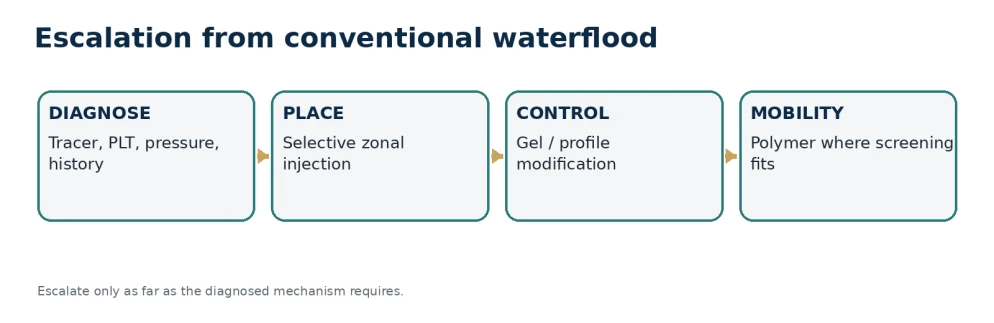
Three families of intervention address different mechanisms: selective injection changes where water enters; conformance treatments reduce flow through dominant channels; polymer mobility control changes how efficiently water displaces oil. The technologies are complementary, but only when matched to the diagnosed sweep problem.
| Observe | Diagnose | Act |
|---|---|---|
| Identify the dominant flow path | Select placement or mobility- control mechanism | Pilot, monitor response, then scale |
1. Three Different Problems - Three Different Responses
| Observed problem | Likely mechanism | Preferred intervention family |
|---|---|---|
| One interval takes most injection | Zonal permeability contrast / completion bias | Selective injection, profile control, mechanical or chemical conformance |
| Fast injector-producer breakthrough | Fracture/thief-zone short circuit | Deep conformance treatment, rate/pressure management |
| Broad poor sweep with viscous oil | Unfavorable mobility ratio | Polymer mobility control |
| Good pressure support but bypassed oil | Areal/vertical heterogeneity | Pattern rebalance + conformance + infill where justified |
2. Anonymized Oman Examples
Oman Field B - polymer pilot as a scale-up decision
A mature Oman clastic asset completed approximately one year of polymer pilot injection and reported positive results. The next decision was whether to expand the concept to additional fault blocks. This is the correct decision
point for a polymer project: not simply “did the pilot inject?”, but “did it improve conformance and incremental recovery sufficiently to justify scale-up under the field's heterogeneity and facilities constraints?”
Oman Field C - profile diagnosis before conformance
In another mature pattern, a logging survey showed that more than 50% of injected water was entering through the toe of a horizontal injector. A conformance treatment was then applied before the producer was returned following lift remediation. This sequence is important because the intervention was based on a measured injection-profile problem rather than on water cut alone.
3. Published Oman Benchmarks
A published South Oman polymer pilot in a lower-permeability, highly heterogeneous sandstone reported clear improvement in injection conformance after switching from water to polymer. The published summary reported approximately 10% incremental oil recovery and an average water-cut reversal of around 12% across the pilot pattern. Fibre-optic surveillance was used to demonstrate the conformance change.
A separate Oman extended polymer injectivity test in a mature sandstone waterflood sustained about 150 m3/d polymer injection at approximately 4,000 kPa maximum surface pressure. Polymer breakthrough was detected at low concentration in two of six surrounding producers, while observed oil gain was lower than simulation expectations. This is equally valuable evidence: injectivity can be proven without automatically proving the full predicted oil response.
4. Global Analogs
Daqing, China - polymer at mature-waterflood scale
Daqing represents one of the world's largest polymer-flood applications. A published comparison of produced- water-compatible polymer versus conventional HPAM reported pre-polymer water cuts around 95-96%. The produced-water system achieved a water-cut reduction of 16.6%, oil increase in all 37 producers, and 3.3% of oil in place more incremental recovery at similar injected volume while using about 35% less polymer. The case illustrates the importance of polymer chemistry, water quality, mobility control and pattern design as an integrated system.
Three established polymer cases - heterogeneity matters
A 2020 comparative study of three established polymer floods showed that reservoir heterogeneity strongly controls incremental recovery and polymer utilization. Higher-quality cases achieved incremental recovery around 12.5-13.7% with maximum water-cut reduction up to 24.4%, while more heterogeneous systems required stronger reservoir-management measures to improve sweep.
| Intervention | Strength | Main risk | Best use |
|---|---|---|---|
| Selective injection / zonal control | Precise and reversible where completion allows | May only move water to another layer | Known profile imbalance |
| Deep gel / conformance | Can block thief zones and fracture shortcuts | Placement uncertainty / re-routing | Discrete dominant high- conductivity paths |
| Polymer mobility control | Improves volumetric sweep over a pattern | Injectivity, degradation, adsorption, water quality, facilities | Unfavorable mobility + heterogeneous sandstone |
| Pattern rebalance | Low chemical dependency | Needs good connectivity model and response time | Systematic areal imbalance |
5. Pilot Design - What Must Be Proven
- Injectivity can be sustained without unacceptable fracture/out-of-zone growth.
- The treatment changes the intended injection profile or mobility behavior.
- Producer response is distinguishable from lift/workover effects.
- Water-cut change and incremental oil are consistent with the mechanism.
- Chemical or intervention utilization is economically scalable.
- Surface facilities can handle polymer preparation, produced fluids and any emulsion/solids effects.
6. Application to Oman
Oman contains many mature, heterogeneous sandstone and carbonate waterfloods where the next barrel is more likely to come from improved sweep than from simply increasing injection volume. The screening sequence should be: prove connectivity, measure zonal intake, identify whether the problem is channeling or mobility, then select the lowest-complexity intervention capable of changing the flow path.
Madar technical principle Polymer, gel and selective injection are not competing answers. They solve different parts of the same sweep- efficiency problem. The correct technology is the one whose mechanism matches the diagnosed reservoir behavior.
References
- Polymerflooding Pilot Applied in Lower-Permeability Heterogeneous Sandstone, Journal of Petroleum Technology (2022), summarizing an Oman SPE case.
- Al Amri, B. et al. (2022). Extended Polymer Injectivity Test in a Medium Viscosity Sandstone Oil Reservoir, Sultanate of Oman. SPE 200031-MS.
- Comparison of Different Polymers Flooding with Fresh and Produced Water in Pu I Layer of Daqing Oilfield. SPE 190446-MS (2018).
- Xu, J. & Lu, X. (2020). Polymer Flood Performance and Incremental Recoveries: Lessons Learned From Three Established Cases with Varied Reservoir Heterogeneities. SPE 202263-MS.
- Anonymized Oman operating records supplied by the client, 2025-2026. Values rounded and identifiers removed.