Madar · Technical Insight Series
Download original PDFTechnical summary based on public literature only. No proprietary field data. This note does not constitute a field-specific engineering recommendation.
Overview
Executive summary
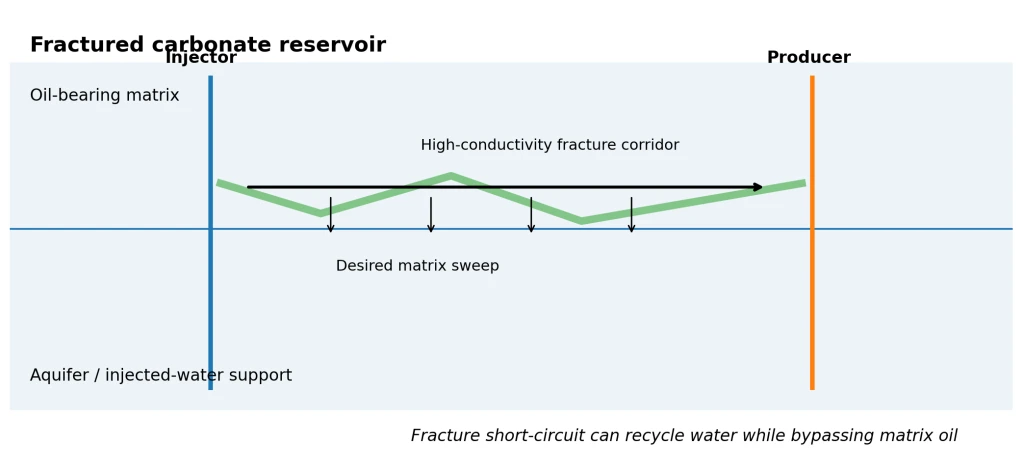
Excess water in naturally fractured carbonate reservoirs is often controlled by a small number of highly conductive faults, fracture corridors or induced fractures rather than by uniform displacement through the rock matrix. Once those pathways connect an aquifer or injector to a producer, water can move rapidly between wells while substantial oil remains bypassed in the matrix. Oman provides several well-documented examples. Published work from the Shuaiba and Kharaib reservoirs shows rapid water breakthrough associated with conductive fracture systems, fracture-dominated injection and poor zonal isolation. Mitigation has ranged from fracture-aware well placement and cemented liners to deep chemical fracture shutoff and redesign of waterflood patterns around dominant fracture orientation. Global analogs reinforce the same conclusion: no single water-control technology is universally correct. The appropriate response depends on whether the dominant mechanism is near-well inflow, a discrete injector-producer shortcut, multiple fracture entries along a horizontal well, or a field-scale directional fracture network. Diagnosis should therefore precede treatment.
1. Why fractured carbonate water breakthrough is difficult
Carbonate reservoirs frequently combine low-to-moderate matrix permeability with highly conductive structural features. A fracture network can be beneficial early in field life because it provides productivity and injectivity. The same network can later become the dominant water conduit. Three effects are especially important: (1) fracture permeability can be orders of magnitude higher than matrix permeability; (2) induced fractures created during water injection can intersect pre-existing natural fractures; and (3) horizontal wells can encounter several fracture corridors, causing highly uneven inflow and very rapid water breakthrough. The result is a characteristic mismatch between gross fluid movement and oil recovery: large volumes of water may circulate while matrix oil remains poorly swept.
2. Published Oman examples
| Field / setting | Observed mechanism | Mitigation | Technical lesson |
|---|---|---|---|
| Yibal - Shuaiba carbonate | Conductive faults/fractures, thief zones, bottom-water rise and behind-casing channeling; horizontal wells increasingly intersected conductive features. | Selective completions, cemented/perforated liners, plug- back and reperforation, 3D targeting, PLT/simulation and improved voidage management. | Water control required both completion isolation and field- scale reservoir management. |
| North Oman - Shuaiba/Kharaib fractured carbonate | Direct injector-producer short circuit. PLT indicated fracture- dominated injection; tracer/biocide response confirmed rapid connectivity. | Deep fracture-penetrating gel injected from the injector; subsequent injection management considered fracture growth and stress orientation. | When a discrete reservoir-scale shortcut is proven, treating the fracture path can be more effective than a near-well mechanical repair. |
| Oman fractured carbonate field - Shuaiba/Kharaib | Early breakthrough aligned with dominant WNW fracture corridors; waterflood response demonstrated directional shortcuts. | Waterflood pattern changed from inverted nine-spot to line drive aligned with dominant fracture/fault trend; dynamic data used to map corridors. | In a systematic fracture network, development geometry can be as important as individual well treatments. |
| North Oman - Natih fractured carbonate mature wells | Very high water cut under aquifer support, with water channeling through fractures in low- permeability carbonate matrix. | Rigless in-depth conformance treatments combining staged mobility-control systems; careful candidate screening and surveillance. | Deep conformance can create incremental oil even in very mature, high-water-cut fractured carbonate wells. |
Oman observation: the recurring pattern is not simply “high water cut.” It is preferential water movement through a small fraction of the connected pore system.
2.1 Yibal - fracture-aware completions and reservoir management
Published PDO studies describe Yibal Shuaiba as a heavily faulted carbonate with matrix permeability generally far below the permeability of thief zones and conductive faults/fractures. Water production accelerated as development matured, and later horizontal wells increasingly intersected water-conductive features. Early barefoot horizontal completions experienced high water cuts, prompting a move toward selective isolation and cemented/perforated liners. The ability to plug back watered-out sections and reperforate alternative intervals became an important optimization tool. The Yibal case also illustrates a critical reservoir-management point: high water production may reflect several mechanisms simultaneously - basal water rise, thief-zone encroachment, fracture flow and behind-casing channeling. A single intervention therefore cannot be selected reliably without diagnosis.
2.2 North Oman - deep fracture shutoff
SPE 98386 documented an injector-producer pair in a naturally fractured Shuaiba-Kharaib reservoir where most injected water entered a fracture-dominated interval and the producer reached approximately 70-90% water cut. A tracer-type biocide test appeared at the producer within about one day, providing strong evidence of direct hydraulic communication. The selected treatment was a deep, fracture-penetrating crosslinked polymer gel placed through the injector. After treatment and resumption of injection, producer water cut fell immediately from roughly 90% to about 75% and remained below the original level for more than a year. The interpretation was that the treatment blocked the connected natural-fracture segment even though injection-induced fracturing could resume nearer the injector.
3. Global analogs
High-temperature fractured carbonates - Mexico
Published case histories describe polymer-gel water and gas shutoff in highly naturally fractured carbonate reservoirs at bottomhole temperatures above 250 F. Fifteen Mexico case histories were reported with one-year post-treatment data. The relevance to Oman is the demonstration that in-depth conformance treatment can remain viable where conventional low-temperature gels would be unsuitable.
Fractured carbonate horizontal wells - Eastern Montana, USA
A 2024 field study documented compartmentalized autonomous inflow control in the Mission Canyon limestone, where natural fractures dominate flow and can connect directly to strong bottom water. The approach was designed to restrict water autonomously in individual completion compartments while retaining oil inflow. The broader lesson is that when numerous fracture entries occur along a horizontal section, distributed downhole control may be preferable to trying to identify and chemically shut every fracture.
Long horizontal open hole - Middle East
A 2021 case study used selective coiled-tubing placement of a customized thixotropic gel in a naturally fractured carbonate horizontal well. The intervention was designed fracture by fracture, combining selective pumping and testing rather than indiscriminate bullheading. The analog demonstrates the value of precise placement where the water-entry interval is known and access is possible.
Fractured carbonate mature wells - Gulf region
Recent published campaigns in mature fractured carbonate wells under aquifer support used staged deep- conformance treatments and reported meaningful water-cut reductions and incremental oil in selected candidates. The broader lesson is that candidate selection and post-treatment surveillance are as important as the chemistry itself.
4. Comparing mitigation strategies
| Mitigation | Best-fit mechanism | Main strength | Main limitation | Oman relevance |
|---|---|---|---|---|
| Selective mechanical isolation / plug-back | Localized water entry or completion problem | Direct, controllable and often reversible | Does not solve reservoir-scale connectivity | Strong where PLT identifies a discrete interval |
| Deep gel / conformance treatment | Discrete fracture shortcut or fracture- fed aquifer channel | Can treat beyond the near-wellbore region | Placement uncertainty; risk of rerouting or fracture reopening | Highly relevant to proven fracture shortcuts |
| Compartmentalized inflow control | Multiple fracture entries along horizontal producer | Controls unwanted fluid locally along the well | Requires suitable completion architecture and design | Attractive for new or recompleted horizontal wells |
| Injection-rate / fracture-growth management | Injection-induced fractures extending into natural network | Reduces creation or extension of shortcuts | May constrain injectivity and pressure support | Important where injection occurs above fracture pressure |
| Pattern redesign | Systematic directional fracture network | Field-scale solution; can improve sweep architecture | Harder to implement in mature fixed well patterns | Relevant early in redevelopment or infill planning |
| Surveillance before intervention | Uncertain mechanism | Avoids treating the wrong problem | Requires data and disciplined interpretation | Should precede expensive intervention |
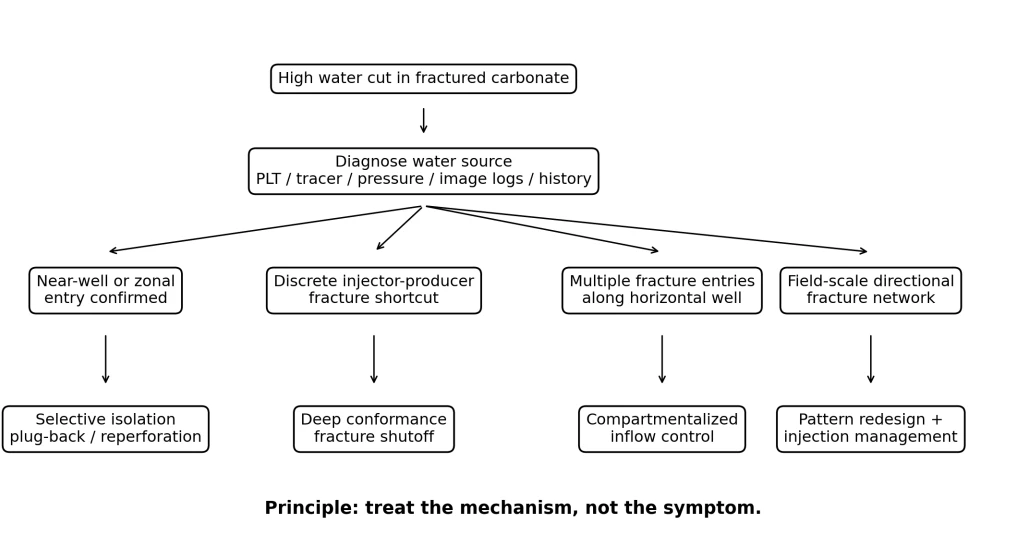
Decision framework for matching mitigation to the dominant water-entry mechanism.
5. Recommended diagnostic sequence
- Reconstruct water-cut, WOR, oil-rate and injection histories at well and pattern level.
- Compare water response with nearby injector changes and pressure history.
- Use PLT, temperature/noise, saturation or image logs to locate entry points where available.
- Use tracer or interference testing to test injector-producer connectivity.
- Interpret fracture orientation together with seismic, image logs, losses and stress information.
- Classify the mechanism: near-well, discrete shortcut, distributed fracture inflow, or field-scale fracture network.
- Select and pilot the least-complex intervention that directly addresses the diagnosed mechanism.
- Define measurable KPIs: water reduction, incremental oil, injectivity, pressure support, sustainability and water- handling savings.
6. Key implications for mature Oman carbonate fields
- High water cut should not automatically be interpreted as uniform flood maturity. In fractured carbonates, a large part of the reservoir may remain unswept while water cycles through conductive corridors.
- Injector behavior is often as important as producer behavior. Excess fracture growth from injection can create the shortcut that later appears as a producer water problem.
- Horizontal wells require fracture-aware completion design. Their productivity advantage can become a water- control disadvantage if they intersect multiple conductive features without selective isolation.
- Deep conformance treatment is most compelling when connectivity is demonstrated, not merely suspected.
- Field-scale fracture architecture should influence infill location, pattern orientation and injection strategy before expensive remedial work is undertaken.
- The strongest workflow is integrated: geology + dynamic data + well diagnostics + surveillance + targeted intervention.
7. Conclusion
The Oman and global literature converge on one central principle: fracture-driven water production is a connectivity problem before it is a water-handling problem. The most successful mitigation strategies diagnose where water is moving, determine the scale of the conductive pathway, and then intervene at the appropriate scale. Near-well isolation, deep conformance, autonomous inflow control, injection management and pattern redesign are complementary tools rather than competing universal solutions. For mature carbonate reservoirs, the decision should therefore be mechanism-led: diagnose first, match the intervention to the flow path, pilot with clear KPIs, and scale only after sustained response is demonstrated.
References
- Al-Shidhani, S. et al. (1996). Horizontal Wells Rejuvenate the Mature Yibal Field. SPE 37059.
- Yibal V2V Team, Petroleum Development Oman (2002). Maximizing Yibal's Remaining Value. SPE 77641.
- Ozkaya, S.I. and Richard, P. (2005). Fractured Reservoir Characterization Using Dynamic Data in a Carbonate Field, Oman. SPE 93312.
- Ligthelm, D.J. et al. (2006). Improved Oil Recovery in Fractured Carbonate Reservoirs: Don't Give Induced Fractures a Chance! SPE 98386.
- Al Mufargi, H. et al. (2023). Water Shutoff in Fractured Carbonate Vertical and Horizontal Wells by Bullhead Chemical Injection: A Success Story. SPE 217009.
- McConnell, M. et al. (2024). Case Study of Autonomous Inflow Control Devices to Control Water Production in Fractured Carbonate Reservoir in Eastern Montana. SPE 218071.
- Pollio, P. et al. (2021). Successful Zonal Isolation in Complex Fractured Carbonate Scenario Using Thixotropic Gel and Hybrid Electric-Fiber Cable Coiled Tubing Technology. SPE 207447.
- Successful High-Temperature, Water-Control Case Histories in Highly Naturally Fractured Carbonate Reservoirs (2010). SPE 135101.
- Field Implementation of Water Shutoff Treatments in Fractured Carbonate Wells by Microgel and Gel Injections (2024). SPE 218538.
This technical note summarizes information reported in published literature. It does not reproduce proprietary field data and does not constitute a field-specific engineering recommendation.