Madar · Technical Insight Series
Download original PDFThis technical insight is based on published literature and general reservoir-engineering principles. Oman field examples cited by name are from public SPE literature. No confidential operator data are reproduced.
Overview
Executive Summary
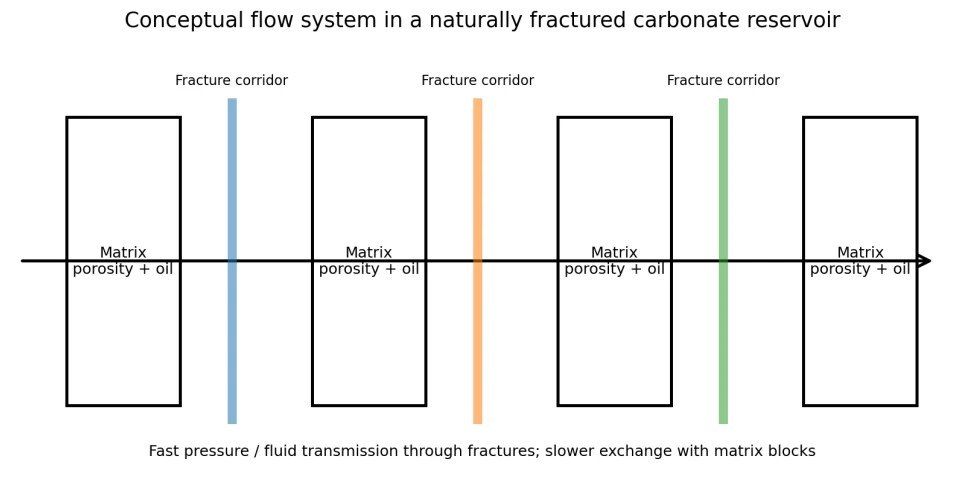
Fractured carbonate reservoirs are not simply high-permeability versions of conventional carbonates. Their performance is governed by two interacting systems: a porous rock matrix that stores most of the hydrocarbons, and a fracture network that can transmit fluids orders of magnitude faster. This contrast can create very high well productivity, but it also creates one of the hardest reservoir-management problems in the industry: pressure support and injected water may preferentially move through fractures while significant oil remains bypassed in the matrix.
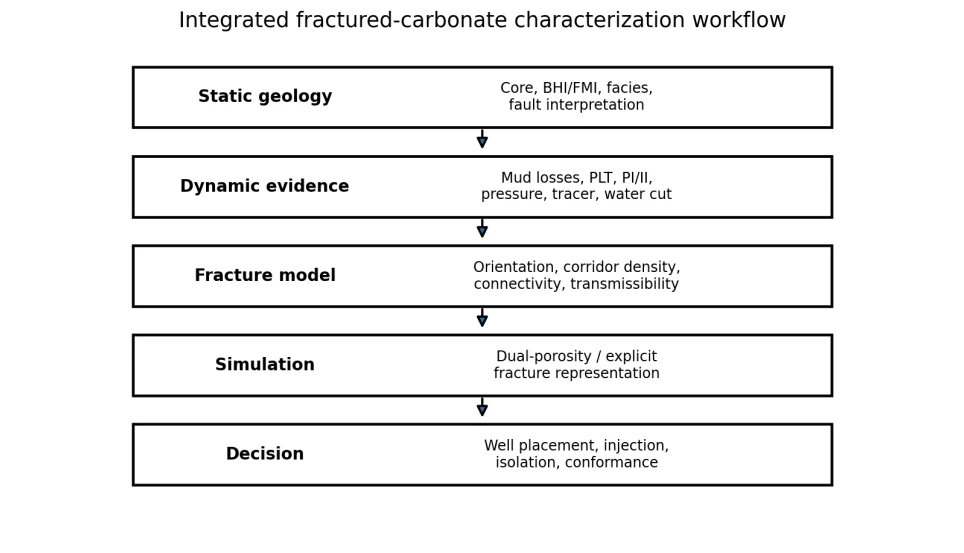
In mature fields, the key question is therefore not whether fractures exist, but which fractures are hydraulically active, how they connect wells, and whether they enhance recovery or short-circuit the displacement process. Static fracture description alone is rarely sufficient. The most reliable models integrate geology, borehole images, mud-loss data, well tests, production and injection profiles, pressure interference, tracers, water-cut evolution and reservoir simulation.
Oman provides particularly instructive examples. Published work from the Yibal Shuaiba reservoir and other North Oman Shuaiba-Kharaib fields shows that conductive fracture corridors can dominate water movement, create rapid injector-producer communication and leave matrix oil poorly swept. The same literature also shows that development can be improved through fracture-aware well placement, selective completions, zonal isolation, injection-pattern redesign, conformance treatment and continuous surveillance.
Five technical messages
| Issue | Implication |
|---|---|
| Storage vs. flow | The matrix commonly stores the oil; fractures commonly control pressure and fluid movement. |
| Not all fractures matter | Many fractures are cemented or poorly connected; a small number of corridors can dominate field behaviour. |
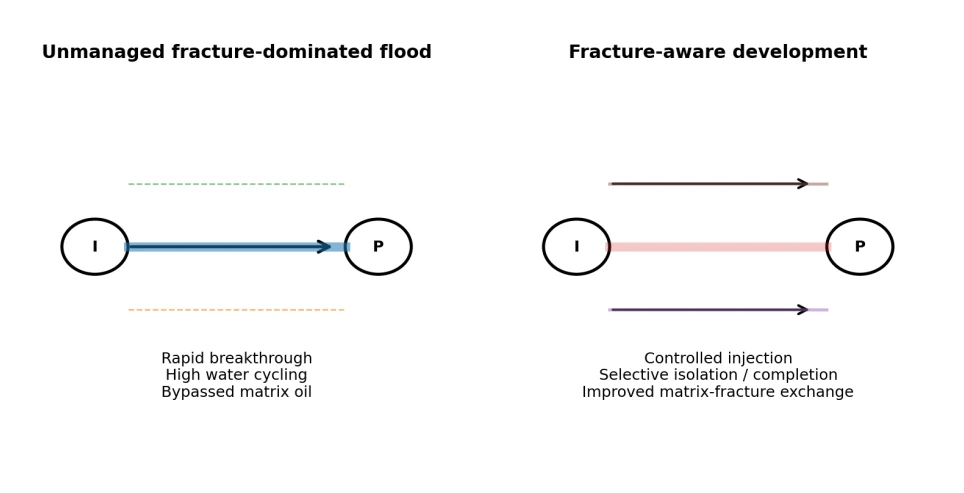
| Waterflood risk | A fracture can convert injection from sweep into recycling if it directly connects injector and producer. |
| Dynamic data are essential | Water cut, PLT, tracer and pressure response often reveal effective fracture connectivity better than static data alone. |
| Intervention must match mechanism | The solution may be pattern redesign, rate control, zonal isolation, gel/conformance, or a new well - not one universal treatment. |
1. What Makes a Fractured Carbonate Reservoir Different?
Carbonates are inherently heterogeneous because depositional facies, dissolution, cementation, dolomitization, stylolitization and burial diagenesis can create strong variations in pore geometry and permeability. Tectonic or diagenetic fractures add another level of heterogeneity. In a naturally fractured reservoir, a relatively small fracture pore volume may provide a disproportionately large fraction of transmissibility.
The most useful conceptual model separates:
Matrix blocks - the dominant hydrocarbon storage volume, often moderate to low permeability.
Fracture corridors - localized, highly conductive flow pathways commonly associated with faults, flexures or deformation bands.
Background joints - widespread but often cemented, poorly connected or hydraulically insignificant.
Large open fractures / mega-fractures - low-volume features that can dominate well productivity or water movement.
Karst, vugs and dissolution features - locally superimposed on the fracture network and capable of creating extreme connectivity.
The dual-porosity consequence: a reservoir can show excellent pressure communication and high gross well rates while still having inefficient displacement of oil from the matrix. This is why high injectivity or rapid response should not automatically be interpreted as effective sweep.
2. How Fractures Control Reservoir Performance
2.1 Productivity enhancement
Open fractures can multiply effective well productivity by connecting the wellbore to a much larger drainage volume. In low-permeability carbonate matrix, this can be the difference between a commercial and non-commercial well.
2.2 Early water breakthrough
The same conductive feature that delivers oil can later deliver water. In waterflooded or aquifer-supported reservoirs, breakthrough may occur much earlier than matrix-flow models predict.
2.3 Injector-producer short circuit
Where an induced injection fracture intersects a natural fracture corridor connected to a producer, injected water may recycle rapidly between wells. Pressure support is maintained, but displacement efficiency can be poor.
2.4 Bypassed matrix oil
Fast fracture flow can sweep the fracture pore volume while leaving significant oil in adjacent matrix blocks. Matrix- fracture transfer then depends on capillary imbibition, gravity, diffusion and local pressure gradients.
2.5 Compartmentalization
Fractures and faults are not always conductive. Cemented damage zones, stylolites and sealing faults can compartmentalize the reservoir. The field can therefore contain conductive corridors adjacent to sealing barriers - a combination that is difficult to predict without integrated data.
3. Characterizing the Effective Fracture Network
A useful fracture model must reproduce dynamic behaviour, not only fracture observations. The objective is to identify the effective network - the subset of fractures that actually transmits reservoir fluids at field scale.
| Data source | What it tells us |
|---|---|
| Borehole image logs | Determine fracture orientation, aperture indicators, clustering and relation to faults. Their limitation is local sampling and uncertainty over whether observed fractures are hydraulically active. |
| Core and petrography | Differentiate open, mineralized and reactivated fractures; establish timing relative to diagenesis and hydrocarbon charge. |
| Mud losses and drilling events | Provide strong evidence of high-conductivity features when aligned with fracture corridors. |
| PLT / injection profiles | Identify the small number of intervals that may take most injection or production. |
| Pressure interference and pulse tests | Quantify effective well-to-well communication and transmissibility. |
| Interwell tracers | Directly test injector-producer connectivity, breakthrough time and flow-path asymmetry. |
| Water-cut and production history | Map the dynamic footprint of conductive corridors, especially when many wells are available. |
| Seismic and structural interpretation | Provide field-scale geometry, fault framework and fracture fairways, but seismic-scale faults should not be assumed conductive without dynamic calibration. |
4. Oman Case Studies from Published Literature
4.1 Yibal Shuaiba - fractures as productivity enhancers and water conduits
Published PDO work on the Lower Cretaceous Shuaiba reservoir at Yibal describes a heavily faulted carbonate with average matrix permeability around 10 mD, local thief zones up to roughly 200 mD, and fault/fracture permeability believed to be orders of magnitude higher. As horizontal drilling intensified, water production increased sharply. The authors linked the acceleration to wells intersecting more conductive faults and fractures, supported by very rapid water breakthrough in vertical wells with fault cut-outs.
The response evolved from conventional pattern development toward fracture-aware reservoir management. Horizontal wells were used to target unswept oil, but completion design became critical. Barefoot horizontals suffered early water breakthrough; selective completions and later cemented/perforated liners improved zonal isolation and allowed watered-out sections to be plugged back or reperforated. The field example demonstrates that fractures are not simply a geological description - they directly determine completion strategy, sweep and ultimate recovery.
4.2 Shuaiba-Kharaib field - mapping conductive fracture corridors
SPE 93312 describes a fractured carbonate field in Oman producing from Shuaiba and Kharaib reservoirs. Waterflooding initially used an inverted nine-spot pattern, but early breakthrough showed that the reservoir was more fractured than anticipated. Borehole-image data, production histories, flowmeter profiles, mud losses and injector- producer shortcuts indicated that water movement was concentrated along WNW-trending fracture corridors. The development pattern was subsequently changed to a line-drive geometry aligned with the dominant structural/fracture trend. This is a powerful example of changing the field-development concept rather than simply treating individual watered-out wells.
4.3 North Oman - induced fracture plus natural fracture short circuit
SPE 98386 documents a naturally fractured Shuaiba-Kharaib reservoir where a tracer/biocide test confirmed rapid communication between a water injector and producer. A PLT indicated that most injected water entered one fracture- dominated interval. The interpreted connection consisted of an induced injection fracture linking into a natural fracture trend near the producer. Deep crosslinked-polymer gel treatment reduced the producer water cut
immediately and remained effective for more than a year. The broader lesson was to manage injection pressure and pattern geometry so induced fractures do not connect to natural fracture corridors.
5. Global Analogues and Transferable Lessons
Fractured carbonates occur across the Middle East, North America, Central Asia and other mature producing provinces. Although rock type, wettability and fracture architecture differ, several global lessons are transferable to Oman.
| Analogue | Transferable lesson |
|---|---|
| Permian Basin carbonate fields, USA | Decades of waterflood and tertiary recovery demonstrate that reservoir characterization, injection profiling, conformance management and pattern-level surveillance are essential when high-permeability features dominate displacement. Published carbonate EOR experience from fields such as SACROC/Kelly- Snyder, Wasson and Slaughter illustrates the value of surveillance before and during tertiary recovery. |
| Naturally fractured carbonate waterfloods | Global field experience consistently shows that waterflood performance can deteriorate when conductive fractures create early breakthrough. The most effective responses combine fracture-aware well placement, pressure/injection control, selective completions and - where connectivity is proven - conformance treatment. |
| Horizontal wells in fractured carbonates | Horizontal wells can improve contact with unswept oil but also increase the probability of intersecting conductive fractures. Compartmentalized or selectively isolated completions therefore become increasingly important as water encroaches. |
| Mature carbonate EOR | CO2, WAG, chemical and other EOR methods can mobilize additional oil, but the fracture network strongly influences injectant distribution. A tertiary process cannot compensate for poor conformance if most injectant bypasses the matrix through a small number of fast paths. |
6. Development and Waterflood Strategy
| Observed behaviour | Recommended technical response |
|---|---|
| If fractures increase productivity but do not connect to water | Exploit them. Place wells to intersect productive fracture corridors while controlling drawdown and monitoring water movement. |
| If one producer is watered out through a known interval | Use selective isolation, plug-back, reperforation or completion-based inflow control. |
| If one injector strongly communicates with one producer | Confirm with tracer/pressure data, then consider injection redistribution, rate reduction or deep conformance treatment. |
| If many wells show the same directional breakthrough | Redesign pattern geometry around fracture orientation; do not treat each well independently. |
| If injectivity is extremely high with weak pressure benefit | Suspect out-of-zone loss, fracture extension or channeling; run injection-profile and pressure diagnostics before increasing rate. |
| If EOR is being considered | First establish where the injectant will go. Fracture |
| conformance is often a prerequisite to economic EOR performance. |
|---|
7. Application to Oman
Oman contains numerous carbonate reservoirs where faults, fracture corridors, thin oil columns, aquifer support and long waterflood histories interact. The public case histories show that the country already has deep technical experience in fractured-carbonate development. The opportunity today is to combine that experience with higher- resolution surveillance and more selective control technologies.
A practical Oman workflow should begin by classifying the water problem at pattern scale: matrix displacement, fracture breakthrough, aquifer encroachment, completion leak, or mixed mechanism. The next step is to quantify connectivity using available production history, injection response, PLT, pressure, tracer and borehole-image data. Only after the mechanism is established should the intervention be selected.
The highest-value opportunities are likely to be patterns where large volumes of water are injected and produced but incremental oil response is weak. These patterns should be screened for direct fracture communication, poor vertical conformance and bypassed matrix oil. A modest reduction in water recycling can create value through both incremental oil and lower lifting, treatment and reinjection load.
MADAR TECHNICAL POSITION In fractured carbonates, the correct question is not “Which water-control technology should we use?” It is “Which flow mechanism is dominating this pattern, and what evidence proves it?” Technology selection should follow that diagnosis.
8. Conclusions
- Fractured carbonate reservoirs are dual systems: the matrix commonly stores most hydrocarbons while a small fracture volume controls much of the flow.
- Fractures can be beneficial during early production and detrimental during waterflood or aquifer encroachment.
- The hydraulically effective fracture network must be defined using dynamic evidence, not static fracture description alone.
- Oman public case histories demonstrate the full spectrum of fracture behaviour: enhanced productivity, early water breakthrough, injector-producer short circuit, bypassed matrix oil and the need for fracture-aware completion and pattern design.
- Waterflood optimization should progress from diagnosis to selective intervention: rate control, pattern redesign, zonal isolation, conformance treatment or new drainage points as appropriate.
- For EOR, conformance comes first. Advanced injectants add limited value if the reservoir is still dominated by uncontrolled fracture bypass.
References
Al-Shidhani, S., Al-Bimani, A., van der Bok, J., Al-Saadi, K., Schoepfer, P. & Verwey, P. (1996). Horizontal Wells Rejuvenate the Mature Yibal Field. SPE 37059.
Yibal V2V Team, Petroleum Development Oman (2002). Maximizing Yibal's Remaining Value. SPE 77641.
Ozkaya, S.I. & Richard, P. (2005). Fractured Reservoir Characterization Using Dynamic Data in a Carbonate Field, Oman. SPE 93312.
Ligthelm, D.J., van den Hoek, P.J., Hos, P., Faber, M.J. & Roeterdink, R.C. (2006). Improved Oil Recovery in Fractured Carbonate Reservoirs: Don't Give Induced Fractures a Chance! SPE 98386.
Manrique, E.J., Muci, V.E. & Gurfinkel, M.E. (2006). EOR Field Experiences in Carbonate Reservoirs in the United States. SPE 100063.
Terrado, M., Yudono, S. & Thakur, G. (2007). Waterflooding Surveillance and Monitoring: Putting Principles Into Practice. SPE 102200.