Madar · Technical Insight Series
Download original PDFPrepared as a public technical note. Confidential field data are not reproduced.
Overview
Executive Summary
Heavy oil is not a single reservoir class. Development performance depends on the interaction between oil viscosity, reservoir temperature, matrix permeability, fractures or vugs, aquifer support, reservoir thickness, depth, wettability, and the ability to distribute heat or mobility-control agents. The central development question is therefore not simply “which EOR method is best?”, but “what physical mechanism prevents the oil from moving, and what process can change that mechanism economically?”
Oman provides unusually valuable heavy-oil analogs. Mukhaizna demonstrates large-scale steamflooding in shallow, viscous-oil sandstone reservoirs and published work also documents thermal development of heavy oil in naturally fractured carbonate intervals. Qarn Alam demonstrates a very different mechanism: steam heats a low-permeability fractured carbonate matrix so that viscosity falls and oil drains by gravity through the fracture network. These examples show that the same injected fluid - steam - can perform very different reservoir functions.
Global analogs reinforce the same lesson. In Alberta, the Grosmont carbonate contains ultraheavy bitumen in karstified, fractured and vuggy dolomite, where gravity-dominated thermal concepts have been preferred over simple displacement. In Syria, cyclic steam stimulation was evaluated for a deep heavy-oil carbonate reservoir where primary recovery was expected to be very low. Recovery technology must be matched to reservoir architecture, not only to oil API gravity.
1. Why Heavy Oil Is Difficult
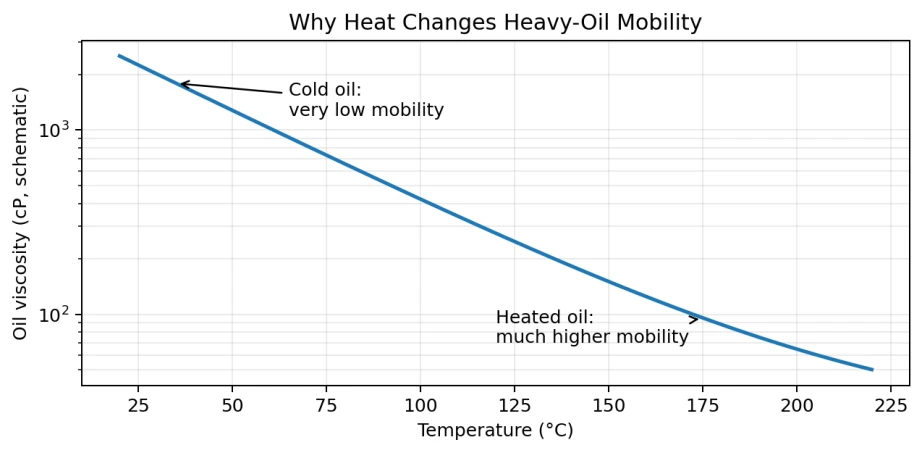
Viscosity is the first-order limitation. At reservoir temperature, heavy oil can be tens, hundreds, thousands, or even millions of centipoise. This reduces well productivity and creates adverse mobility ratios when water is injected. The result can be early water breakthrough, poor sweep and very low recovery even where oil saturation is high.
API gravity alone is not enough. Published Middle East carbonate data show that oils of similar API gravity can differ in viscosity by an order of magnitude. For screening, viscosity at reservoir temperature is therefore more useful than API alone.
- High viscosity reduces matrix-to-fracture transfer and well productivity.
- Strong aquifers can move water rapidly through fractures while leaving viscous oil behind in matrix blocks.
- Steam can reduce viscosity dramatically, but heat loss increases with depth and poor vertical conformance.
- Unconsolidated sands introduce sand-control and artificial-lift constraints that may dominate the development concept.
- Fractured carbonates require explicit treatment of fracture connectivity, matrix transfer and gravity drainage.
2. Heavy-Oil Reservoir Types and Recovery Mechanisms
| Reservoir type | Typical limiting mechanism | Recovery concepts to screen |
|---|---|---|
| High-permeability sandstone | Poor oil mobility; adverse water/oil mobility ratio | Steamflood, SAGD or modified SAGD, polymer where viscosity range permits, solvent hybrids |
| Fractured low-permeability carbonate | Oil trapped in matrix; fractures carry | Thermally assisted gravity drainage, |
| fluids quickly | fracture-heating concepts, CSS in selected settings | |
|---|---|---|
| Vuggy/karstified carbonate bitumen | Extreme viscosity plus complex fracture/vug connectivity | Gravity-dominated thermal processes, CSS/SAGD variants, solvent-thermal hybrids |
| Moderately viscous sandstone | Sweep rather than absolute mobility may dominate | Polymer flood, selective injection, conformance control |
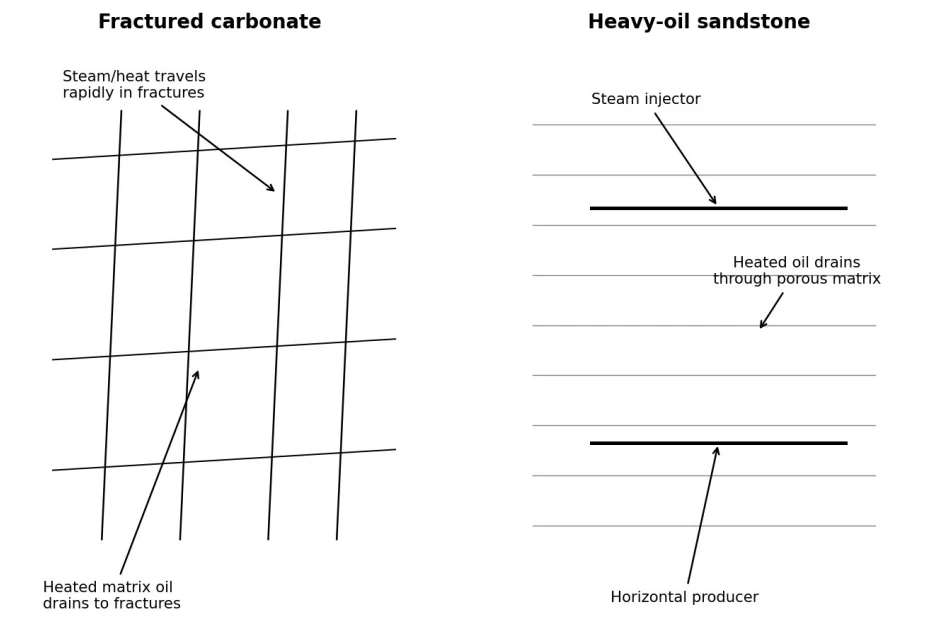
Conceptual difference between thermal recovery in fractured carbonate and porous sandstone
3. Oman Example - Mukhaizna
Mukhaizna in southern Oman is one of the region's most important heavy-oil thermal developments. Published descriptions place the main heavy oil in shallow Permian Gharif sands, with approximately 14- 18° API crude. Large-scale development has used horizontal producers supported by steam injection, with field performance managed through steam distribution, bottomhole pressure, water handling and artificial lift.
The technical lesson from Mukhaizna is that thermal recovery is a system rather than an injection project. Steam generation, steam quality, zonal placement, well spacing, producer drawdown, temperature surveillance, artificial lift and produced-water handling are all coupled. A steam project can be thermally mature in one pattern and underheated in another even within the same field.
Published Mukhaizna work also documents heavy oil in naturally fractured carbonate intervals where very high viscosities created low cold productivity. Thermal development required approaches different from conventional sandstone steamflooding because fractures dominate heat and fluid transport. This creates an Oman analog that links heavy-oil development directly to fractured-reservoir understanding.
4. Oman Example - Qarn Alam
Qarn Alam is a naturally fractured Shuaiba carbonate containing approximately 16° API oil with viscosity around 220 cP at reservoir conditions in published studies. The matrix permeability is low and most of the oil resides in matrix blocks, while fractures provide the high-conductivity network. Under cold production, strong water drive through fractures and poor matrix oil mobility resulted in very low expected recovery.
The thermal concept is therefore not a conventional steam drive. Steam is injected into the fracture network primarily to heat the matrix and reduce oil viscosity. Once heated, oil drains from the matrix toward the fracture system under gravity. This process is commonly described as thermally assisted gas- oil gravity drainage (T-GOGD/TAGOGD).
The Qarn Alam experience illustrates three important principles: fractures can be an advantage when they distribute heat effectively; matrix transfer can be more important than fracture flow itself; and the reservoir must be monitored as a moving thermal system rather than only through injection and production rates.
5. Global Analog - Grosmont, Alberta
The Grosmont Formation in Alberta contains an enormous bitumen resource in dolomitized, fractured, vuggy and locally brecciated carbonate. Initial bitumen viscosity can be in the millions of centipoise. Decades of pilots have shown why conventional displacement concepts struggle: at initial conditions the oil is effectively immobile and reservoir pressure may be too low to establish an efficient drive process.
Published Grosmont work therefore emphasizes gravity-dominated processes, including steam-based recovery and hybrid concepts. Historical cyclic-steam pilots demonstrated that heat could mobilize bitumen, while later studies evaluated SAGD and related geometries. The key analog for Oman is not the absolute viscosity but the interaction of fractures, vugs, heat distribution and gravity drainage.
6. Global Analog - Deep Carbonate Heavy Oil, Syria
Published work on the Oudeh field in Syria evaluated cyclic steam stimulation in a deep carbonate reservoir containing 12-16° API crude. Primary recovery was estimated at only about 5-7% of oil in place. The case is important because the reservoir depth was greater than that of many successful CSS projects, making heat loss and steam delivery major uncertainties.
This analog demonstrates that a thermal process cannot be screened on viscosity alone. Depth, completion design, heat losses, fracture behavior, steam injectivity and cycle economics must be evaluated together before a pilot can be justified.
7. What the Analogs Mean for Oman
| Observed condition | Likely dominant issue | Preferred technical question |
|---|---|---|
| Shallow viscous sandstone with good permeability | Oil mobility | Can steam reduce viscosity enough at acceptable SOR and heat loss? |
| Fractured carbonate with low matrix permeability | Matrix oil cannot reach fractures fast enough | Can fractures distribute heat and gravity drainage mobilize matrix oil? |
| Moderate viscosity but poor waterflood | Mobility ratio / heterogeneity | Would polymer or conformance control |
| sweep | outperform thermal EOR? | |
|---|---|---|
| Very high viscosity with thick reservoir | Near-immobile oil | Is a gravity-driven thermal process more robust than cyclic or displacement processes? |
| Deep reservoir | Heat loss / steam deliverability | Does thermal efficiency survive depth, or should non-thermal processes be prioritized? |
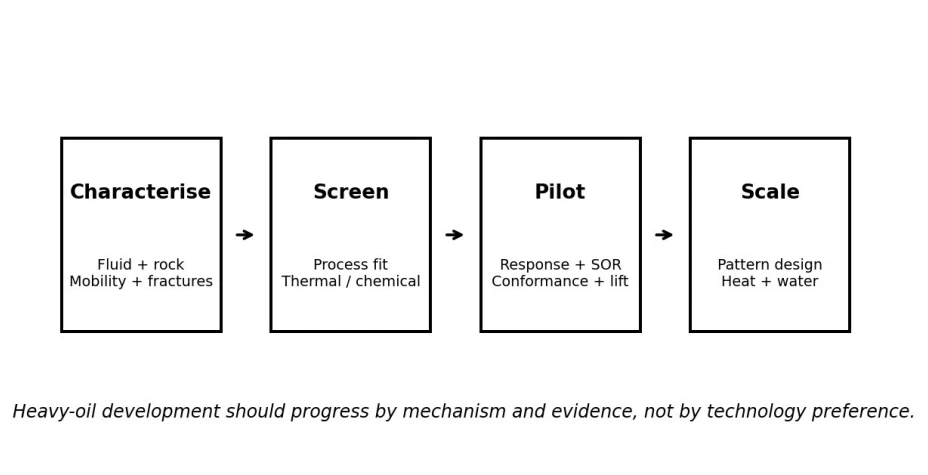
Recommended heavy-oil screening workflow
8. A Practical Screening Framework
For a new Oman heavy-oil opportunity, the first screening package should contain enough information to determine the controlling recovery mechanism before any technology is selected.
- Fluid: API gravity, live and dead-oil viscosity versus temperature, solution GOR, asphaltene behavior.
- Rock: matrix permeability, porosity, fracture/vug system, net thickness, vertical barriers, wettability.
- Thermal: depth, initial temperature, overburden heat loss, injectivity, expected steam quality at sandface.
- Dynamic: aquifer strength, pressure depletion, water cut, interference, productivity and injectivity.
- Development: horizontal-well feasibility, lift limits, sand production, water-handling capacity and fuel/steam economics. The pilot should then test the uncertain mechanism, not merely demonstrate that steam or another fluid can be injected. For thermal projects, key pilot KPIs include steam-oil ratio (SOR), heat-front growth, temperature response, incremental oil, pattern communication, water production, artificial-lift reliability and the sustainability of response after steam redistribution.
9. Key Takeaways
- Heavy oil should be classified by mobility and reservoir architecture, not API gravity alone.
- In sandstone, steam often acts primarily by reducing viscosity and creating a movable heated zone.
- In fractured carbonate, steam may act mainly as a heat-delivery mechanism that accelerates matrix- to-fracture gravity drainage.
- Fractures may be either an asset or a liability: they can distribute heat efficiently, or short-circuit injected fluids and water.
- Polymer and conformance technologies should remain in the screening set where viscosity and reservoir temperature permit; not every heavy-oil field requires steam.
- The best Oman development strategy is therefore mechanism-led: diagnose the mobility bottleneck, screen global analogs, pilot the highest uncertainty, then scale.
References
- Buza, J.W. (2008). An Overview of Heavy and Extra Heavy Oil Carbonate Reservoirs in the Middle East. IPTC 12426.
- Penney, R.K. et al. (2007). First Full Field Steam Injection in a Fractured Carbonate at Qarn Alam, Oman. SPE 105406-MS.
- Hartemink, M. et al. (1995). Qarn Alam: Application of Simulation for Steam Pilot Design in a Fractured Reservoir. European IOR Symposium.
- Al-Shizawi, A., Denby, P.G. & Marsden, G. (1997). Heat-Front Monitoring in the Qarn Alam Thermal GOGD Pilot. SPE 37781- MS.
- Malik, S. et al. (2010). Modified SAGD in Multiple Zones at Mukhaizna. SPE 129248-MS.
- Malik, S. et al. (2018). Steamflooding Heavy Oil in a Naturally Fractured Carbonate Reservoir in Sultanate of Oman: A Case Study. SPE 190478-MS.
- Al Mahruqi, H., Al Habsi, A. & Mohammed, H. (2019). Surveillance Approach of Steam Management in Heavy Oil Reservoir - Oman. SPE 197321-MS.
- Al Qasabi, N. et al. (2024). Full Field Implementation of Physics-Based Analytical Model to Optimize Steamflood in Mukhaizna Heavy Oil Field in Oman. SPE 218544-MS.
- Yuan, J-Y. et al. (2010). Evaluation of Recovery Technologies for the Grosmont Carbonate Reservoirs. Journal of Canadian Petroleum Technology, 49(5).
- Song, Q., Chen, Z. & Ali, S.M. (2015). Steam Injection Schemes for Bitumen Recovery from the Grosmont Carbonate Deposits. SPE 174463-MS.
- Li, M. et al. (2010). A Simulation Study of a Cyclic Steam Stimulation Pilot in a Deep Carbonate Heavy Oil Reservoir in Oudeh Field, Syria. SPE 137603-MS.
Publication note: This article synthesizes published literature and general technical interpretation. Internal field-development material was used only as background context; confidential field values, commercial terms and proprietary operator data are not reproduced. Any external publication should still undergo confidentiality and rights review.