Madar · Technical Insight Series
Download original PDFOverview
Executive summary
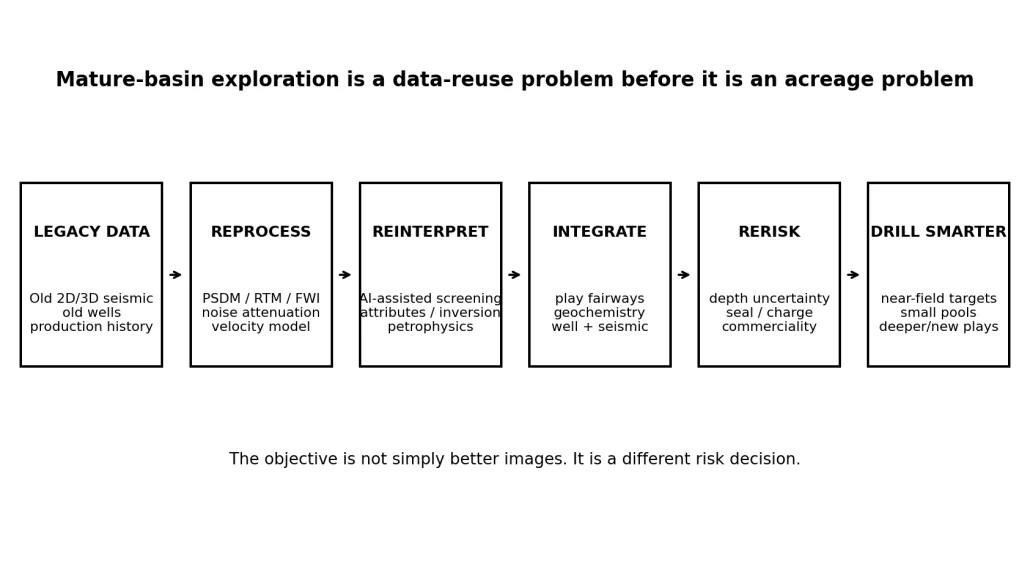
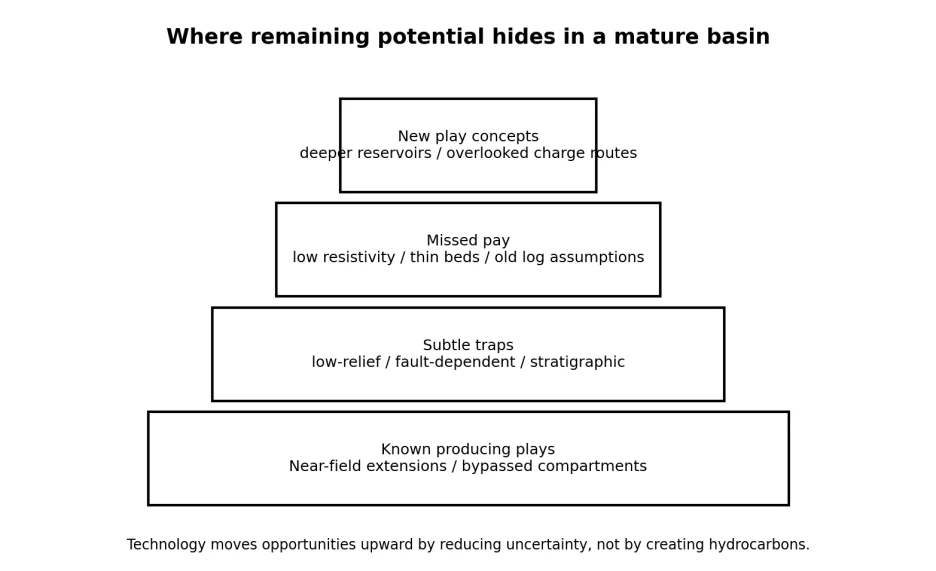
Mature basins are often described as 'creamed' after decades of drilling. That description is usually only partly correct. What becomes exhausted first is the inventory of obvious structures visible with the technology, velocity models, log interpretation and commercial thresholds of the previous exploration cycle. Remaining hydrocarbons increasingly sit in smaller closures, subtle fault-dependent traps, stratigraphic traps, deeper or poorly imaged intervals, bypassed compartments and pay that was previously misclassified. The exploration problem therefore shifts from finding large obvious structures to reducing multiple small uncertainties well enough that a modest opportunity becomes drillable and commercial.
An anonymized Oman data set reviewed for this note illustrates the point: a heavily explored area still generated a portfolio of roughly 30 mapped opportunities after modern 3D processing and reinterpretation. Several of the key risks were not simply 'is there a structure?' but low structural relief, depth conversion, charge, fault-seal effectiveness, variable reservoir quality and fluid phase. In another mature trend, petrophysical reinterpretation identified possible missed pay across several established reservoir intervals. These are exactly the classes of uncertainty that modern imaging, inversion, AI-assisted interpretation and integrated petroleum-system workflows are designed to attack.
1. Why mature basins still work
A mature basin contains an unusually valuable exploration asset: data density. It may have hundreds of wells, decades of production, multiple vintages of 2D and 3D seismic, pressure data, cores, image logs, fluid samples, dry-hole information and known field performance. The paradox is that the same basin may be under-explored with respect to questions that older technology could not answer.
2. The technology shifts that matter
Reprocessing before reacquisition. Modern prestack depth migration, anisotropic velocity modelling, reverse-time migration and full-waveform-inversion-style velocity updates can change the geometry of low-relief or faulted traps. In a mature basin, the value often comes from reprocessing existing data rather than immediately acquiring more seismic.
Quantitative seismic and rock physics. Acoustic/elastic impedance, simultaneous inversion, spectral decomposition and carefully calibrated attributes can distinguish lithology, porosity trends and reservoir presence where structure alone is insufficient. The goal is not an attractive attribute map; it is a geological prediction tied to wells.
AI-assisted interpretation. Machine learning is useful for repetitive, high-volume tasks: horizon tracking, fault detection, seismic facies screening, analog search and ranking large lead inventories. The highest value comes when AI accelerates interpretation while experienced geoscientists retain control of the geological model and risking.
Modern petrophysics. Legacy Archie assumptions, shoulder-bed effects, conductive minerals, microporosity and complex carbonate pore systems can cause pay to be missed or water saturation to be overstated. Reprocessing old logs with modern saturation models, NMR/image-log calibration and core data can create exploration targets without a new seismic survey.
Integrated petroleum-system re-risking. Charge, migration timing, fault seal and phase risk become proportionally more important as structural size decreases. Basin modelling, geochemistry, pressure data, fault juxtaposition analysis and regional play fairways should be integrated with the seismic prospect rather than treated as separate studies.
Cloud-scale data integration. A mature basin usually has too much data, not too little. Searchable digital subsurface libraries, standardized well/seismic metadata and AI retrieval allow old reports, failures and analogs to become active exploration inputs rather than forgotten archive material.
3. An anonymized Oman example
A recent Oman exploration portfolio provides a useful mature-basin example. The area contains several established plays and decades of drilling. Modern reprocessing and reinterpretation nonetheless identified about thirty opportunities in one sector. The new portfolio was dominated by small-to-moderate targets rather than giant structures, and the principal uncertainties were low-relief closure, charge access, fault seal, reservoir effectiveness and depth conversion. Seven seismic volumes were used to cross-check interpretation, while newly delivered PSDM data materially improved imaging.
The lesson is important: the technology did not make the basin less mature. It changed which uncertainties could be measured. A prospect that appears non-viable on time-domain or legacy depth maps may become drillable once velocity uncertainty is reduced. Conversely, a lead may disappear when modern depth conversion removes apparent closure. Both outcomes create value because they improve capital allocation.
In the same broad mature-basin setting, old wells were re-examined using updated petrophysical concepts and possible missed pay was identified in multiple reservoir intervals. Elsewhere, reprocessed 3D data supported rapid maturation of clustered near-field leads around proven production. These examples show why the best mature-basin program combines imaging, petrophysics and play understanding rather than relying on any single technology.
4. Worldwide analogs
| Mature province | Technology lever | What it changes | Transferable lesson |
|---|---|---|---|
| North Sea | Broadband/legacy seismic reprocessing, OBN, 4D and quantitative interpretation | Smaller near-field closures, compartment boundaries and reservoir prediction become more reliable | Infrastructure-led exploration can remain economic when uncertainty and tie-back distance are low. |
| Gulf of Mexico | Wide-/full-azimuth imaging, RTM and advanced velocity | Previously obscured structures beneath complex | Imaging technology can reopen acreage believed to be |
| modelling | overburden become imageable | exhausted when the original limitation was illumination rather than geology. | |
|---|---|---|---|
| Onshore mature basins | High-density 3D, attributes, reprocessed logs and AI- assisted screening | Thin beds, subtle faults, stratigraphic traps and overlooked pay can be ranked rapidly | The value of AI is scale and consistency; geological validation remains essential. |
| Middle East mature provinces | Depth reprocessing, inversion, fault-seal analysis and near- field portfolio optimization | Small structures and deeper plays can be combined with existing infrastructure | Commercial threshold falls when new discoveries can use existing wells, roads, pipelines and facilities. |
5. Where technology creates the most value
The mature-basin opportunity set can be screened into four categories. First are near-field targets around producing infrastructure, where even modest volumes may work commercially. Second are subtle structural or fault-dependent closures where depth and seal uncertainty dominate. Third is missed or bypassed pay in old wells. Fourth is genuinely new play space - deeper reservoirs, different trapping styles or migration pathways that were not part of the original exploration model.
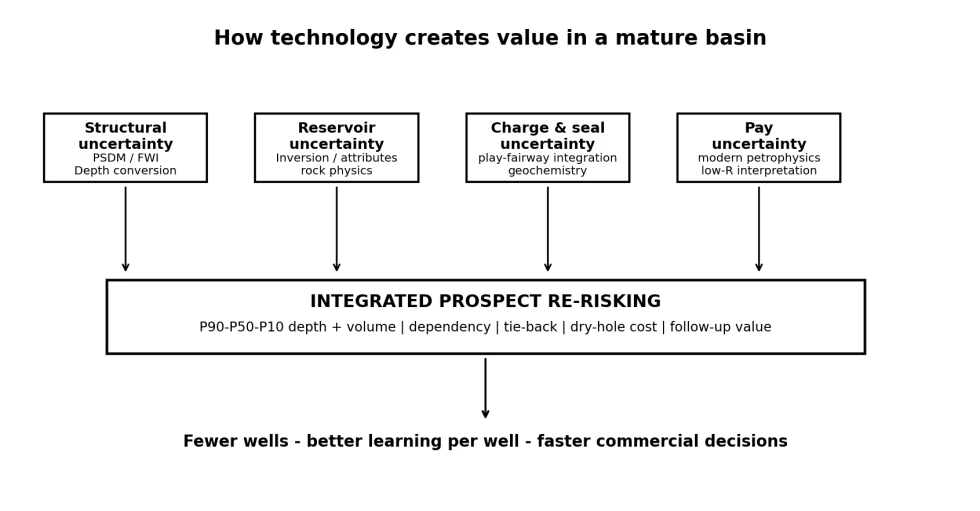
Technology should be matched to the uncertainty. A better seismic image cannot solve a charge problem. AI cannot turn a poorly calibrated velocity model into a reliable depth closure. Inversion cannot prove hydrocarbons without a rock-physics framework. The mature-basin workflow therefore starts by asking: what uncertainty is preventing a decision, and which data or technology can materially reduce it?
6. A practical mature-basin workflow for Oman
- Build a single digital inventory of seismic vintages, wells, dry holes, discoveries, pressure and geochemistry.
- Reconstruct why each historical prospect succeeded or failed; do not classify every dry hole as a failed play.
- Reprocess the seismic where imaging or velocity uncertainty is decision-critical.
- Reinterpret old wells with modern petrophysics and consistent stratigraphy.
- Generate play-fairway and dependency maps before ranking individual prospects.
- Use AI to accelerate fault/horizon/lead screening, but retain geoscientist QC and geological accountability.
- Quantify depth, volume and risk uncertainty stochastically rather than presenting a single deterministic map.
- Rank opportunities by commercial value including tie-back distance, shared infrastructure and follow-up potential.
- Design each exploration well as an information well: pressure, fluid, image logs, cores and formation testing should be selected to unlock the next portfolio decision.
7. What this means for Oman
Oman is particularly suited to this approach because many producing areas combine long exploration histories, multiple stacked plays, complex faulting, variable carbonate and clastic reservoir quality, salt influence in some basins, and extensive existing infrastructure. The remaining prize is unlikely to be dominated by a single technology or one spectacular new play. It is more likely to come from repeated small improvements in imaging, depth conversion, reservoir prediction, petrophysics, charge risking and commercial screening.
That changes the exploration mindset. A mature basin should not be judged by the number of wells already drilled. It should be judged by whether the current data can still answer the questions needed to make today's exploration decisions.
The next discovery in a mature basin may already be present in the data - but
not in the interpretation.
8. Key conclusions
- Reprocessing legacy data can create as much value as acquiring new data when the main uncertainty is imaging or depth conversion.
- AI is most valuable as an interpretation accelerator and archive-search engine, not as an autonomous prospect generator.
- Modern petrophysics can turn old wells into new exploration evidence.
- Near-field economics allow smaller discoveries to matter when infrastructure already exists.
- Every dry hole should be converted into play knowledge; mature basins become more valuable when failure data are integrated rather than forgotten.
- The winning workflow is technology-neutral: diagnose the uncertainty first, then deploy the tool that reduces it.
Selected technical basis
Internal Oman exploration workshop materials reviewed for this note: modern 3D reprocessing/PSDM, near-field exploration screening, play-fairway mapping, low-resistivity-pay reinterpretation and probabilistic prospect risking. Field, operator and prospect identifiers are intentionally omitted.
Public mature-basin practice: depth imaging, quantitative seismic interpretation, rock physics, fault-seal analysis, 4D/OBN surveillance and infrastructure-led exploration across the North Sea, Gulf of Mexico and other established petroleum provinces.
Madar Technical Insight series: petroleum systems, waterflood surveillance, fractured carbonates and heavy-oil recovery provide complementary examples of how reinterpreting legacy data can change technical decisions.
Data and confidentiality note
This article uses generalized and anonymized learnings from technical material available to the author together with published industry practice. Field, operator, prospect and well identifiers have been removed. Numerical examples are intentionally high-level. Any external publication should be reviewed against the confidentiality, ownership and disclosure obligations applicable to the underlying source material.