Madar · Technical Insight Series
Download original PDFExecutive summary
Mature waterfloods usually underperform not because water injection has stopped working as a concept, but because injected water no longer translates efficiently into pressure support, areal sweep and vertical sweep. Heterogeneity, fractures, thief zones, mobility ratio, injectivity limits, completion design and surface constraints progressively decouple injected barrels from incremental oil. Oman experience and global analogs show that the highest-value response is to diagnose connectivity and sweep before adding injection volume.
1. The central problem: injection is not the same as sweep
A field can maintain a high voidage replacement ratio while still losing waterflood efficiency. Water may circulate rapidly through already swept rock, enter only a few high-permeability layers, short-circuit through fractures, or fail to reach poorly connected compartments. The result is rising water handling cost with declining incremental oil per barrel injected.
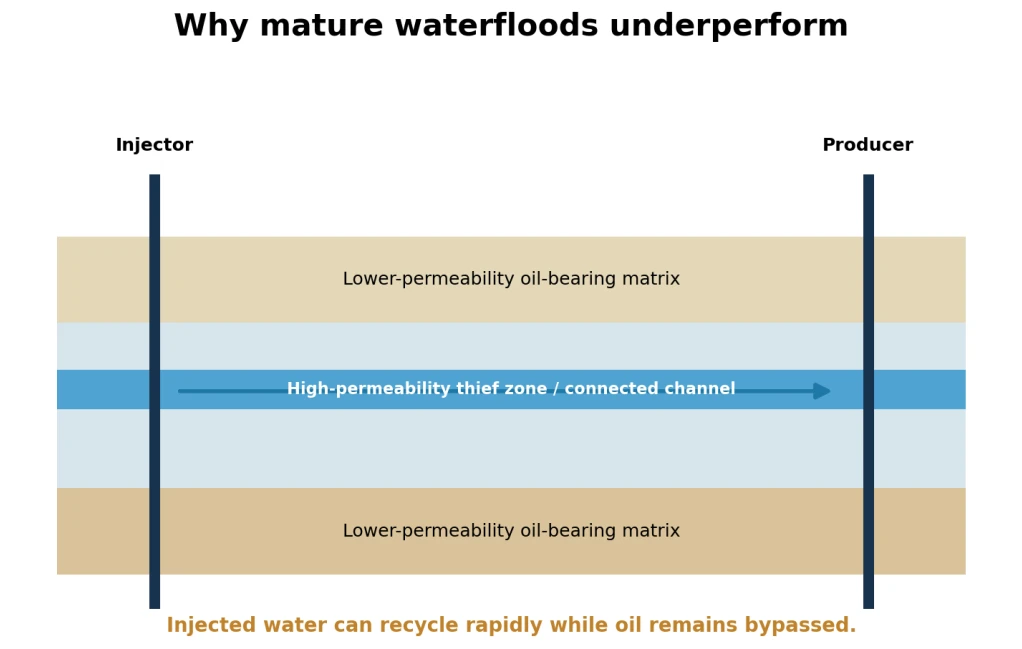
- Areal sweep loss: preferential pathways connect selected injectors and producers.
- Vertical sweep loss: high-permeability layers dominate intake while lower-permeability oil remains unswept.
- Mobility problems: injected water is much more mobile than oil and fingers through the reservoir.
- Operational limits: injectivity, artificial lift, pressure, produced-water handling and facility constraints prevent the subsurface plan from being executed.
2. Oman examples
| Case | Waterflood challenge | Action | Lesson |
|---|---|---|---|
| Yibal - Shuaiba carbonate | Faults, fractures and thief zones generated bypassed matrix oil and complex water movement. | Integrated 3D modelling, PLTs, revised voidage management, selective well optimisation and improved completion isolation. | The flood must be managed in 3D; well-by-well optimisation alone misses connected reservoir behaviour. |
| South Oman heterogeneous sandstone polymer pilot | Conventional waterflood left mobility and conformance limitations in a heterogeneous reservoir. | Polymer injection pilot with extensive surveillance and conformance monitoring. | Mobility control can recover oil that additional water alone cannot efficiently displace. |
| Oman fractured carbonate field | Early breakthrough revealed that an inverted nine-spot pattern conflicted with the dominant fracture architecture. | Pattern changed to a line drive aligned with the main fault/fracture orientation; fracture corridors mapped using dynamic data. | Pattern geometry should reflect the reservoir connectivity framework, not an idealised geometric pattern. |
| Large Oman polymer-flood development | Scaling polymer injection from pilots to many patterns introduced major subsurface and surface operating requirements. | Integrated polymer preparation, injection quality, well surveillance and surface/subsurface optimisation. | EOR success at scale is an operating-system problem, not only a laboratory viscosity problem. |
3. Global analogs
| Analog | Challenge | Intervention | Transferable lesson |
|---|---|---|---|
| Daqing, China | Mature waterflood with high water cut and remaining oil in heterogeneous sandstone. | Large-scale polymer and later ASP flooding after decades of waterflooding. | Changing mobility and displacement efficiency can materially extend a mature waterflood, but requires extensive pattern management. |
| Greater Burgan, Kuwait | Large mature sandstone waterflood with need for lower- carbon incremental recovery. | Polymer-flood pilots and expansion focused on mobility control and integration with existing facilities. | Chemical EOR must be designed around injectivity, produced- water chemistry, logistics and economics. |
| Deep sandstone, Colombia | High-temperature sandstone with mature waterflood opportunity. | Polymer implementation following laboratory qualification and pilot design. | Polymer flooding is increasingly feasible outside traditional low-temperature settings when chemistry and injectivity are qualified. |
| Established polymer floods across varied heterogeneity | Different reservoir architectures produced different response times and incremental recoveries. | Pattern-specific polymer deployment and surveillance. | Heterogeneity controls both response magnitude and timing; analog selection must therefore be reservoir-specific. |
4. A better mature-waterflood workflow
| Step | Question | Typical tools |
|---|---|---|
| 1. Diagnose | Where is injected water actually going? | Pressure surveillance, allocation, PLT, tracer, saturation logs, production history. |
| 2. Quantify connectivity | Which injectors dominate which producers? | Interference, tracers, rate-response analytics, streamline / simulation. |
| 3. Identify bypassed oil | Where is remaining mobile oil relative to swept pathways? | Static/dynamic model integration, saturation surveillance, 4D data where justified. |
| 4. Rebalance | Can rates, patterns or completions improve sweep before adding chemistry? | Injection redistribution, selective injection, producer optimisation. |
| 5. Improve mobility / conformance | Is water too mobile or concentrated in thief zones? | Polymer, gel/conformance, selective control. |
| 6. Verify economics | Does each intervention convert water- handling cost into incremental oil? | Incremental oil per injected barrel, water disposal cost, facility constraint value. |
5. KPIs that matter
- Incremental oil per incremental barrel of water injected.
- Pattern pressure support and pressure communication, not field-average VRR alone.
- Breakthrough timing and slope of water-cut increase.
- Injection allocation by zone and injector-producer connectivity.
- Produced-water handling cost and constrained oil caused by liquid capacity.
- Persistence of response after intervention.
Key takeaway
A mature waterflood underperforms when injected water is no longer converted efficiently into sweep and incremental oil. The response should be connectivity-led: diagnose, rebalance, improve conformance, then escalate to mobility-control or EOR where the reservoir mechanism supports it.
References
- Yibal V2V Team (2002). Maximizing Yibal's Remaining Value. SPE 77641.
- Ozkaya, S.I. & Richard, P. (2005). Fractured Reservoir Characterization Using Dynamic Data in a Carbonate Field, Oman. SPE 93312.
- Al-Sulaimani, H. et al. Successful Polymer Flood Pilot Application in Lower Permeability Heterogeneous Sandstone Reservoir in the South of the Sultanate of Oman. SPE 200051-MS.
- Historical Polymer Flood Oil Gain through Outstanding Subsurface and Surface Integrated Operations. SPE 211444-MS (2022).
- Wang, D. et al. The Engineering and Technical Aspects of Polymer Flooding in Daqing Oil Field. SPE 64722-MS (2000).
- Wang, D. et al. Pilot Tests of Alkaline/Surfactant/Polymer Flooding in Daqing Oil Field. SPE 36748-PA.
- Polymer Flood Performance and Incremental Recoveries: Lessons Learned From Three Established Cases with Varied Reservoir Heterogeneities. SPE 202263-MS (2020).
- Polymer Flooding for a Sustainable Future: Case Studies of Low-Carbon EOR in Greater Burgan Field - South- East Kuwait. SPE 232591-MS (2026).