Madar · Technical Insight Series
Download original PDFExecutive summary
Oman contains several linked petroleum systems rather than a single source-reservoir pair. The Neoproterozoic-Early Cambrian Huqf/Ara system, Paleozoic clastics, Permian-Triassic carbonates, Cretaceous carbonate reservoirs, regional seals, salt tectonics and later foreland deformation combine differently across South, Central and North Oman. The key exploration lesson is timing: source maturity, hydrocarbon migration, trap formation, salt movement, uplift and preservation must work in the correct sequence.
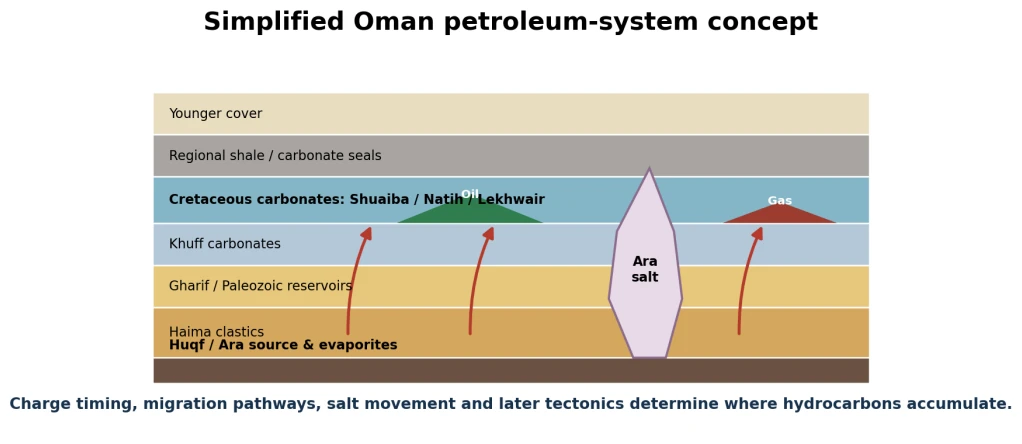
1. Core petroleum-system elements in Oman
| Element | Principal Oman examples | Role |
|---|---|---|
| Source | Huqf / Nafun and Ara organic-rich intervals; locally younger source rocks including Natih | Generate distinct oil and gas families over long geological time. |
| Reservoir | Haima clastics, Gharif sandstones, Khuff carbonates, Shuaiba, Natih and Lekhwair carbonates | Provide a wide range of clastic and carbonate storage systems. |
| Seal | Ara evaporites, intraformational shales, Nahr Umr and Fiqa regional seals, tight carbonates | Preserve accumulations and compartmentalise reservoirs. |
| Trap | Salt-related closures, fault blocks, anticlines, stratigraphic pinch-outs, carbonate build-ups and foreland structures | Create structural and stratigraphic closure. |
| Migration | Carrier beds, faults, salt margins and long- distance lateral pathways | Connect source kitchens to reservoirs, sometimes over very large distances. |
2. Regional Oman framework
| Region | Dominant characteristics | Exploration implications |
|---|---|---|
| South Oman Salt Basin | Early source maturation, Ara evaporites, salt dissolution/movement and later remigration; shallow post-Cambrian reservoirs can depend on early stored charge. | Charge preservation and salt-edge evolution can be as important as present- day maturity. |
| Central Oman / Ghaba system | Paleozoic clastic plays, deep source kitchens and evidence for long-distance lateral migration. | Prospects may depend on regional carrier systems rather than a local mature source directly beneath the trap. |
| North Oman / foreland | Cretaceous carbonate systems superimposed on older petroleum systems and modified by Late Cretaceous-Tertiary deformation. | Trap timing, structural inversion, burial history and seal integrity become critical. |
| Deep Paleozoic | Higher maturity and deeper reservoirs, commonly increasing gas potential. | Thermal history and preservation risk dominate; seismic imaging can be challenging around salt and structural complexity. |
3. Published Oman evidence
Regional basin modelling by Terken, Frewin and Indrelid demonstrated that much of North and Central Oman depends on migration from restricted source kitchens, and that geochemical tracers can indicate long-distance migration on the order of hundreds of kilometres. The same work showed that South Oman can preserve very early hydrocarbon charge beneath or within the Ara salt system before later release and remigration. These observations make Oman a particularly strong example of why petroleum systems must be treated dynamically through geological time rather than as a static source-reservoir map.
- Ara salt acts simultaneously as seal, structural driver and control on migration pathways.
- Multiple uplift and inversion events modify migration direction and trap timing.
- North Oman foreland burial created younger kitchen areas while deformation affected pre-existing traps.
- Different source intervals generate distinguishable oil families, enabling source-to-oil correlation and migration reconstruction.
4. Global analogs
| Global analog | Similarity to Oman | Key difference / lesson |
|---|---|---|
| East Siberian Neoproterozoic-Cambrian systems | Very old source-reservoir systems with major evaporite influence and long preservation history. | Demonstrates that Precambrian-Cambrian systems can remain highly prospective when seal and preservation are exceptional. |
| Tarim Basin, China | Deep Paleozoic source-reservoir systems affected by repeated tectonism and long- distance migration. | Shows how multi-stage charge, structural reactivation and preservation can dominate exploration risk. |
| North Sea salt provinces | Salt movement strongly controls trap geometry, migration and seismic imaging. | Younger system, but a useful process analog for salt-related structuring and migration around diapirs and withdrawal zones. |
| Gulf of Mexico salt basins | Evaporite tectonics create complex migration pathways, minibasins and structural traps. | Demonstrates how salt can both block migration and focus it along margins and welds. |
| Arabian Plate Mesozoic petroleum systems | Regional carbonate reservoirs, excellent evaporite seals and multiple superposed source systems. | Oman adds exceptional older Huqf/Ara systems and stronger foreland/obduction overprint in the north. |
5. Why the petroleum-system framework still matters after discovery
| Development issue | Petroleum-system / geological control |
|---|---|
| Compartmentalisation | Fault history, salt movement and structural reactivation define barriers and conduits. |
| Waterflood behaviour | Depositional architecture, fractures and diagenesis determine connectivity and sweep. |
| Fluid distribution | Charge history, spill, remigration and biodegradation influence oil properties and contacts. |
| EOR selection | Wettability, mineralogy, fractures, oil viscosity and reservoir temperature reflect geological history. |
| Infill / near-field exploration | Understanding migration fairways and trap evolution helps distinguish bypassed opportunity from charge-limited rock. |
Key takeaway
Oman is a multi-system petroleum province. Its exploration potential is best understood by linking source maturity, charge timing, regional migration, salt tectonics, trap formation and preservation. The same geological framework continues to influence reservoir behaviour long after first oil.
References
- Terken, J.M.J., Frewin, N.L. & Indrelid, S.L. (2001). Petroleum Systems of Oman: Charge Timing and Risks. AAPG Bulletin 85(10), 1817-1845.
- Terken, J.M.J. (1999). The Natih Petroleum System of North Oman.
- Konert, G. et al. (2001). Paleozoic Stratigraphy and Hydrocarbon Habitat of the Arabian Plate. GeoArabia.
- Loosveld, R.J.H. et al. (1996). The tectonic evolution of interior Oman. GeoArabia.
- AAPG (2014). An Overview of Pre-Devonian Petroleum Systems - Unique Characteristics and Elevated Risks.
- AAPG Memoir 106. Petroleum Systems of the Tethyan Region - Petroleum Geology of the Sultanate of Oman.
- Published regional studies of the South Oman, Ghaba and Fahud salt basins and associated Huqf/Ara petroleum systems.