Madar · Technical Insight Series
Download original PDFOman operating examples use anonymized, rounded data derived from confidential materials supplied by the client. Field, well and operator identifiers are intentionally omitted. External publication should be subject to rights- holder/confidentiality review.
Executive Summary
As waterfloods mature, the produced-water system can become the real production constraint. High water cut increases lift load, corrosion, chemical usage, separation duty, disposal requirements and injection demand. Once total-liquid or water-handling capacity is reached, otherwise economic oil can become stranded.
The strongest mature-field strategies treat produced water, injection and reservoir management as one system. Produced-water reinjection (PWRI) can convert a disposal liability into pressure support, but only when water quality, injectivity, compatibility and pattern placement are technically controlled.
| Observe | Diagnose | Act |
|---|---|---|
| Quantify water volumes, quality, cost and capacity | Link facilities bottlenecks to reservoir opportunity | Reuse water where technically fit and protect injectivity |
1. The Water Cycle in a Mature Waterflood
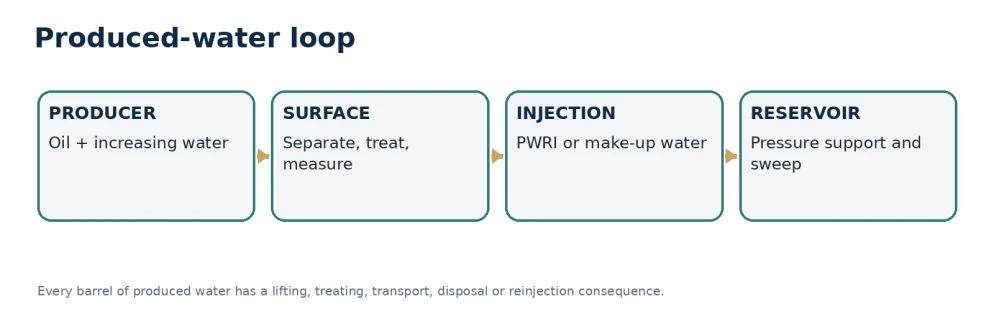
2. Anonymized Oman Operating Example - water handling becomes development-critical
In a mature Oman clastic development, high water cut in a group of producing wells had made water handling a major operating issue. The asset was simultaneously pursuing the elimination of produced-water dumping to evaporation ponds and evaluating two strategic routes: wider use of dedicated water-supply wells, or improved produced-water reinjection with a progressive phase-out of disposal. The decision was tied to a future facilities investment and commissioning program rather than treated as a stand-alone disposal project.
The same asset reported a higher leak burden in the area with greater water production, reinforcing the connection between reservoir maturity and asset integrity. Chemical treatment cost was also rising. These effects mean that the economic value of a waterflood intervention should include avoided water lifting, chemicals, corrosion, handling and disposal - not only incremental oil.
Oman Field C - capacity expansion as an enabler
A separate Oman asset implemented a produced-water handling upgrade of roughly 20 thousand barrels of water per day together with higher-pressure injection capability. This is a useful reminder that a waterflood can be subsurface-ready but facility-constrained. Increasing injection or liquid withdrawal without corresponding water handling can simply move the bottleneck downstream.
| Constraint | Reservoir consequence | Economic consequence |
|---|---|---|
| Separator / water handling capacity | Producer choke-back or inability to increase liquid drawdown | Deferred oil |
| Injection pump pressure/capacity | Inability to maintain target VRR or inject into tighter zones | Lost pressure support / sweep |
| Poor PWRI quality | Injectivity decline and near- wellbore damage | Workovers, filtration and lost injection |
| Corrosion / solids / bacteria | Flowline and tubing failures | Integrity cost and downtime |
| Disposal dependence | Water removed from flood system | Disposal cost and make-up-water demand |
3. Global Analogs
Bangko, Indonesia - total liquid capacity as the limit
Published surveillance work reported that total liquid production at Bangko reached about 550,000 B/D, effectively hitting facility capacity. At that point waterflood optimization was constrained by surface capacity and facilities expansion was being evaluated. This is a classic example of the subsurface and surface systems becoming inseparable late in field life.
Onshore Abu Dhabi - produced-water reinjection
A published case from a giant onshore Abu Dhabi field described replacing aquifer water with produced water in an injection cluster. The project illustrates the potential of PWRI to reduce disposal demand while preserving pressure-maintenance and sweep functions. The key technical risks are water quality, solids/oil content, scaling, souring, compatibility and injectivity.
Daqing, China - produced water as EOR make-up
In Daqing, produced water has been used for polymer solution preparation in large-scale chemical EOR. Published field comparison reported sustained injectivity and improved sweep with a produced-water-compatible polymer system, demonstrating that produced water can be integrated into advanced recovery when chemistry and water quality are engineered together.
4. PWRI Screening Framework
| Screening question | Why it matters |
|---|---|
| Is the produced water compatible with the injection formation water? | Controls scaling and formation damage risk. |
| What are oil, solids, bacteria and oxygen levels? | Controls injectivity loss, souring and corrosion. |
| Where will the water be reinjected? | Disposal and pressure-maintenance objectives require different well placement. |
| Is injection below or above fracture pressure? | Changes conformance, containment and out-of-zone risk. |
| What is the full-cycle water cost? | Determines whether treatment, reinjection or disposal creates highest value. |
| Is surface capacity synchronized with subsurface plan? | Avoids creating a new bottleneck after reservoir optimization. |
5. Application to Oman
For Oman mature fields, the highest-value opportunities are likely to be those where a reservoir action reduces both water production and surface burden, or where PWRI simultaneously solves a disposal issue and supports sweep. Candidate ranking should therefore use a combined metric: incremental oil + avoided water cost + integrity benefit + capacity released.
Madar technical principle Produced water should be managed as part of the reservoir development system. The correct question is not “How do we dispose of more water?” but “How do we reduce unnecessary water, reuse fit-for-purpose water, and convert handling capacity into incremental oil?”
References
- Terrado, M., Yudono, S. & Thakur, G. (2007). Waterflooding Surveillance and Monitoring: Putting Principles Into Practice. SPE 102200.
- Produced-Water Reinjection - Case Study From Onshore Abu Dhabi. Journal of Petroleum Technology (2016), based on an SPE case history.
- Comparison of Different Polymers Flooding with Fresh and Produced Water in Pu I Layer of Daqing Oilfield. SPE 190446-MS (2018).
- Produced Water Manual, Petroleum Technology Transfer Council (PTTC), South Midcontinent Region.
- Anonymized Oman operating records supplied by the client, 2025-2026. Values rounded and identifiers removed.