Madar · Technical Insight Series
Download original Word documentAuthor-supplied technical perspective. Field examples are presented as provided in the source document; application decisions require field-specific validation.
Introduction
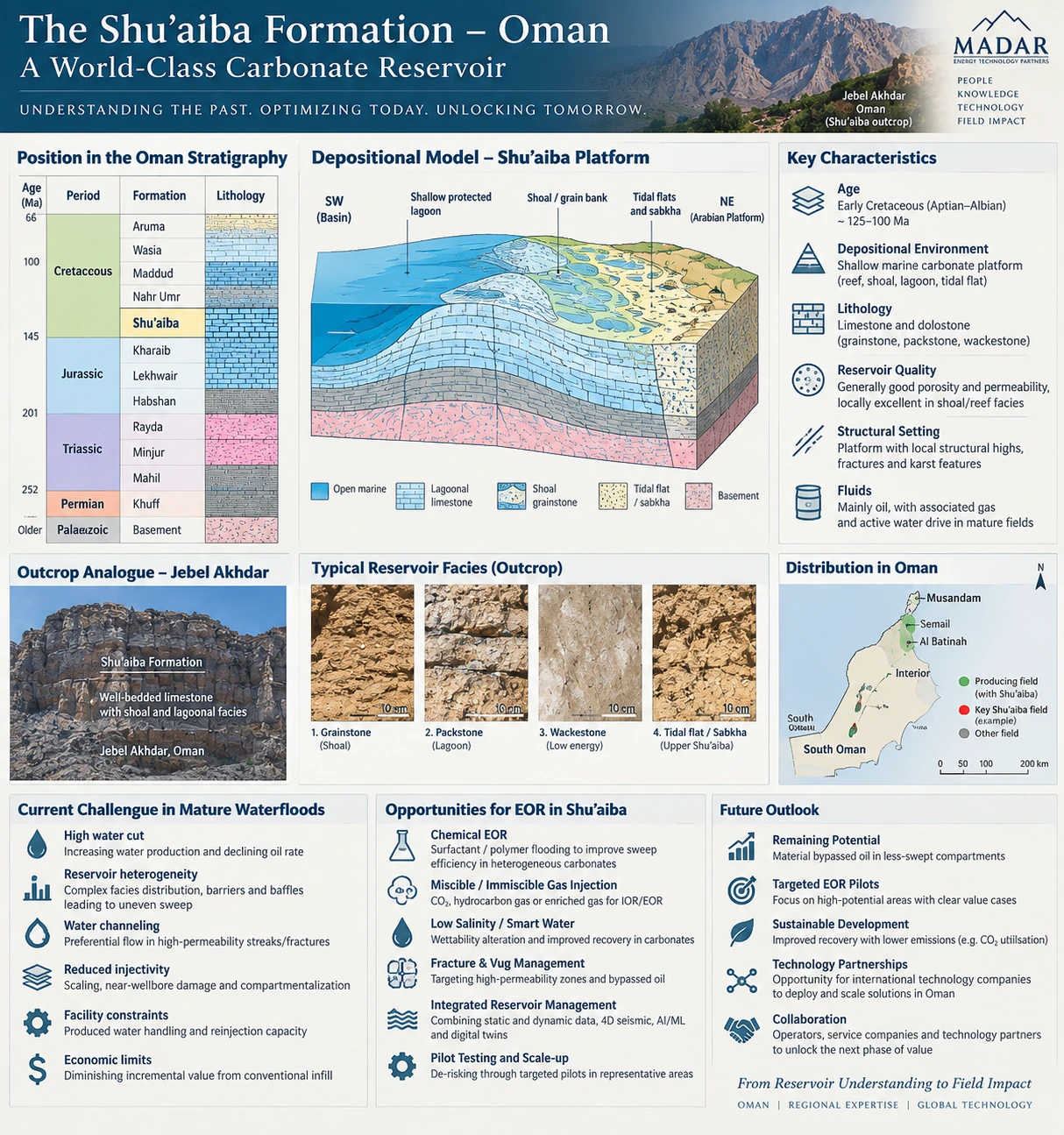
The Shu’aiba Formation is one of Oman’s most important Lower Cretaceous carbonate reservoirs. Deposited during the Aptian, it formed across a broad, warm, shallow-marine carbonate platform that extended over much of the Arabian Plate. Its depositional architecture, reservoir heterogeneity and long production history make it an excellent example of how carbonate geology directly controls field development, waterflood performance and future EOR potential.
For Madar, the Shu’aiba is particularly relevant because it illustrates a recurring challenge in mature carbonate fields: high recovery may already have been achieved in some areas, yet significant movable oil can still remain in unswept, poorly connected or structurally isolated compartments.
Geological Setting
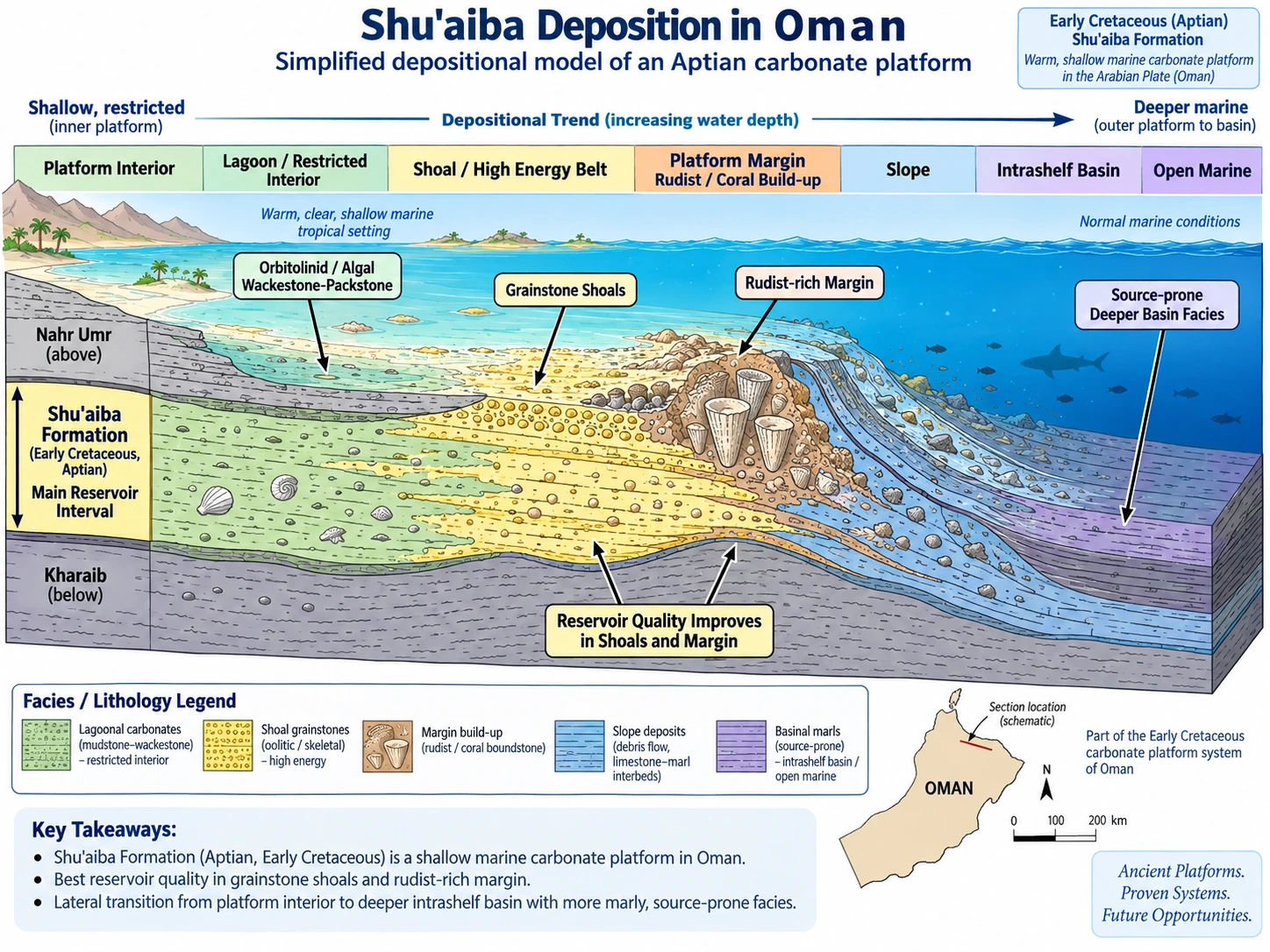
The Shu’aiba consists predominantly of limestone deposited across a gently sloping carbonate shelf. The depositional system ranged from shallow platform interior environments through higher-energy shoals and rudist-rich margin facies into deeper intra-shelf basin settings.
Typical lithologies include:
- wackestone and packstone
- grainstone in higher-energy settings
- rudist-bearing carbonate intervals
- muddy carbonate baffles
- locally chalkified or leached intervals beneath unconformities
The top of the Shu’aiba is commonly an unconformity overlain by the Nahr Umr Formation, which forms an important regional seal.
A key element of the regional system is the relationship between the carbonate platform and the Bab intra-shelf basin. This depositional setting strongly influenced the distribution of reservoir-quality facies and the development of Upper Shu’aiba sequences.
Reservoir Architecture
The Shu’aiba should not be treated as a single homogeneous carbonate body.
Field studies in Oman show that it can contain several vertically stacked flow units separated by lower-porosity baffles. In one mature Oman field, the Upper Shu’aiba reservoir is approximately 183 ft gross thickness, subdivided into multiple flow units with significant vertical variation in reservoir quality.
The wider Oman data indicate several recurring reservoir styles.
USh2 reservoirs commonly contain relatively thick net reservoir sections, locally stronger fracture development, moderate aquifer support and a tendency toward water coning.
USh3 reservoirs are typically thinner and more isolated, often showing weaker aquifer support and stronger solution-gas-drive behaviour.
LS2 reservoirs may contain thicker reservoir sections with moderate aquifer support.
This variability is central to mature field behaviour. Two Shu’aiba fields only a short distance apart may respond very differently to depletion, water injection and well placement.
Development History
Oman’s Shu’aiba reservoirs have been developed using a combination of horizontal drilling, multilaterals, artificial lift, water injection and detailed reservoir modelling.
A useful field analogue shows production beginning in 1993 under primary depletion. Initial reservoir pressure was approximately 2,963 psi, declining to around 1,500 psi before water injection was introduced.
At the time of the development study:
- STOOIP was approximately 32 MMSTB
- cumulative oil production was approximately 3.8 MMBO
- recovery factor was approximately 11.9%
- several producers had already been shut in because of high water cut
- three producers were converted to water injectors
The development plan was designed to place additional producers and injectors in areas containing remaining mobile oil and to improve sweep of lower parts of the oil column.
This illustrates an important point: in carbonate reservoirs, low recovery is not always a consequence of poor reservoir quality. It may instead reflect poor sweep, pressure depletion, compartmentalisation and incomplete connection between injection and production wells.
The Mature Waterflood Problem
As a Shu’aiba waterflood matures, the development challenge changes.
The early question is:
How do we establish pressure support and improve recovery?
The later question becomes:
Where is the remaining oil, and how do we recover it without producing uneconomic volumes of water?
Experience from mature Shu’aiba waterfloods in Oman shows several recurring problems.
High water cut
As water encroaches through the reservoir, oil rate declines while water production rises. Mature wells can remain technically productive but become economically constrained by water handling.
Uneven sweep
Baffles, facies changes, fractures and faults can create highly non-uniform displacement. Water may preferentially move through more transmissive intervals while bypassing oil elsewhere.
Water coning and channelling
Thicker or more fractured reservoirs are particularly vulnerable to rapid movement of water toward horizontal producers.
Attic oil
Oil may remain above existing horizontal wellbores, particularly where structure, completion geometry and vertical sweep are unfavourable.
Bypassed oil
Mature-field studies in Oman have demonstrated that commercial oil can remain in relatively small unswept compartments even after decades of water injection.
Oil behind pipe
Existing wells may contain intervals with significant remaining oil saturation that were never perforated or were previously isolated.
Increasing water-handling burden
Future barrels often require disproportionately large volumes of produced water. This creates constraints in lifting, separation, treatment, reinjection and operating cost.
Ageing well architecture
Older wells introduce additional integrity and intervention challenges. In mature Oman fields, liner integrity and intervention complexity have sometimes limited otherwise attractive redevelopment options.
What Mature Shu’aiba Fields Teach Us
One of the most important lessons from mature Oman waterfloods is that a good waterflood does not necessarily eliminate opportunity.
In one giant mature Shu’aiba field, recovery had already exceeded 50%, yet significant remaining oil was still identified through integrated modelling and surveillance.
Successful redevelopment concepts included:
- additional perforations
- short-radius fishbones
- infill drilling
- targeted drainage of attic oil
- identification of remaining high-oil-saturation sweet spots
- water shutoff and stimulation
- improved reservoir surveillance
Infill drilling was particularly effective, with economic bypassed oil encountered in most targeted areas.
The conclusion is powerful:
The remaining oil in a mature carbonate waterflood is often not uniformly distributed. It exists as a portfolio of smaller, technically identifiable opportunities.
Surveillance Before EOR
For a mature Shu’aiba waterflood, the first priority should not automatically be chemical EOR.
Before selecting an EOR process, the operator needs to understand:
- which injectors communicate with which producers
- where injected water is actually entering
- which intervals are already swept
- where mobile oil remains
- whether water movement is matrix-dominated or fracture-dominated
- whether poor performance is caused by reservoir heterogeneity, completion design or both
This creates a strong role for modern surveillance technologies.
Potential applications include:
- interwell tracers
- production logging
- saturation logging
- fibre-optic monitoring
- zonal injection measurement
- intelligent completion systems
- time-lapse reservoir monitoring
- high-resolution dynamic modelling
- AI-assisted pattern surveillance
The objective is to move from volumetric injection management to sweep-efficiency management.
Conformance Control
Once preferential water movement has been diagnosed, conformance control can become a major recovery tool.
Potential applications include:
- selective water shutoff
- gel systems
- polymer gels
- zonal isolation
- profile modification
- selective injection control
The objective is not simply to reduce water production.
It is to redirect injected water away from already swept high-transmissibility pathways and toward unswept oil-bearing rock.
This distinction is important. Successful conformance treatment should improve both water management and oil displacement.
Future EOR Potential
After the conventional waterflood has been optimised, additional recovery may become possible through EOR.
Polymer flooding
Polymer can improve mobility control and sweep efficiency where reservoir conditions, salinity, temperature and injectivity are favourable.
In heterogeneous carbonate reservoirs, polymer may provide particular value where injected water is moving too rapidly through higher-permeability rock.
Low-salinity or smart water
Changing injected-water chemistry may alter wettability and improve microscopic displacement efficiency in certain carbonate systems.
Its application requires careful laboratory validation.
Surfactant systems
Surfactant-based processes may reduce residual oil saturation, but economics, adsorption and chemical compatibility can become significant constraints in carbonate reservoirs.
Miscible or near-miscible gas
CO₂, hydrocarbon gas or enriched gas may be relevant in selected compartments where pressure, fluid properties and containment permit.
Targeted EOR
The future of EOR in mature Shu’aiba reservoirs is unlikely to be a field-wide blanket treatment.
A more attractive approach may be:
identify remaining oil → classify the recovery mechanism → select the appropriate technology → pilot in a representative pattern → scale only where economics are demonstrated.
The Transition Zone Opportunity
The Oman development material also identifies potential future recovery from what was described as paleo oil between the base of mobile oil and the free-water level.
This transition-zone volume can be significant, but it presents a more difficult displacement problem.
Potential recovery depends on:
- remaining oil saturation
- capillary pressure
- relative permeability
- vertical communication
- water injection placement
- pressure support
- achievable drawdown
In some cases, injectors positioned low in the oil column may help move mobile oil upward toward production wells.
This is an area where targeted EOR and advanced reservoir surveillance could become particularly valuable.
From Waterflood to Reservoir Intelligence
The next stage of Shu’aiba development should therefore be viewed as an integrated reservoir-management problem rather than simply an injection problem.
A modern workflow would be:
Characterise → Diagnose → Monitor → Correct Sweep → Target Remaining Oil → Pilot EOR → Scale
For technology companies, this creates a wide range of possible applications in Oman:
- intelligent zonal injection
- reservoir tracers
- fracture diagnostics
- conformance control
- water shutoff
- polymer systems
- fibre-optic monitoring
- advanced saturation surveillance
- digital waterflood optimisation
- AI-assisted remaining-oil identification
Conclusion
The Shu’aiba Formation demonstrates both the strength and complexity of Oman’s carbonate reservoirs.
It can deliver strong productivity, respond effectively to water injection and achieve high recovery. But as the waterflood matures, development becomes increasingly dependent on understanding small-scale reservoir heterogeneity, water movement and the distribution of remaining oil.
The future opportunity is therefore not simply to inject more water.
It is to answer three questions:
Where is the water going? Where is the remaining oil? Which technology can economically connect the two?
That is where the next generation of surveillance, conformance and EOR technologies can create value in Oman’s mature Shu’aiba reservoirs.
Madar perspective: From reservoir understanding to targeted technology deployment.